Posted on

New NPPF seeks to remove the obstacles blocking housing delivery

It feels like we see in every new year with a new National Planning Policy Framework (NPPF). This time it was a consultation on a draft version of the Framework, which is open until 10th March 2026.

The NPPF underpins all planning policy and decision-making in the UK, and is the government’s way of setting the standards for local plans and decision makers. Until this latest draft was published, the NPPF was largely strategic in focus, setting out principles to guide the plan-making process but not getting involved actual day to day policy.

This new version is a departure from this approach. Though many in the industry are focussing on reforms to Green Belt and the like, as we are fortunate enough to not have any Green Belt in Norfolk or Suffolk, I have summarised the changes that could affect rural planning in our area.

Reforms to Biodiversity Net Gain (BNG) to help small sites

The new NPPF builds on earlier consultation documents, and confirms that the government will be bringing in a total exemption from BNG for all sites under 0.2 hectares in size. Details are due to follow this spring, but it looks likely that the exemption will come into effect this year.

The introduction of a new ‘medium’ category of development of up to 2.5 hectares or 10-49 dwellings seeks to unlock opportunities for small and medium sized housebuilders (SME), and BNG will be ‘streamlined’ for this category. This size of development will also be relieved of some of the validation requirements of major schemes.

National development management policies (NDMP)

For the first time, the draft NPPF is introducing development management policies at a government level to ensure consistency across the country. These will be a material consideration in decision-making, and where a Local Plan is inconsistent with the NDMP, the Local Plan policy should be given very little weight.

Accelerating the Local Plan preparation process

Preparing a Local Plan under the current regulations takes at least 4 years. The draft NPPF introduces a new 30-month (2.5 year) process with three key ‘gateways’ to streamline the process.

Nature Restoration Fund

Nutrient Neutrality has stalled some developments for years. The NPPF proposes putting the onus on Natural England to deliver mitigation schemes which developers can then buy into to unlock their development.

Minor reforms to planning for heritage assets

Wording on heritage considerations in the NPPF has remained largely unchanged for years. The NPPF has not re-written the rules on heritage, but it has streamlined the assessment process and clarified some of the more ambiguous wording.

There are now three clear categories of heritage harm: harm, substantial harm and total loss, and there’s even a definition of ‘harm’. The ambiguous ‘less than substantial harm’ definition is gone, and there is now a more positive tone to this section of the Framework, which encourages approval, and lists energy efficiency and low carbon measures as examples of benefits which can outweigh harm to heritage assets.

My thoughts

The standout change in this draft NPPF is undoubtedly the reforms to BNG. It never made sense to expect applications for minor developments like a new access or a single dwelling to go through what is quite an onerous process, entailing Section 106 agreements and expensive surveys.

The new ‘medium category’ for development is a long overdue gift for SME housebuilders and rural development in general, which nearly always falls into this category, and bears the burden of surveys and reports far more heavily than larger developments.

I am sceptical of the streamlined local plan process – it doesn’t seem significantly different to the current process, and the 30-months could easily be exceeded if amendments are needed or issues emerge at any stage of the process.

I welcome the changes to heritage assessments, as the previous wording was ambiguous and rendered it almost impossible to justify a scheme where any level of harm to a heritage asset was possible.

Overall, the draft NPPF seems driven by pragmatism and a genuine understanding of the issues that need to be overcome in order to deliver more homes. That is what we have needed for several years, and I welcome it.

Posted on

Rural Housing Week shines a spotlight on affordable housing

rural housing week

This year’s Rural Housing Week seeks to highlight the role of housing associations (who deliver and manage affordable housing) in achieving ‘levelling up’ in rural areas. The provision of more affordable housing in rural areas is seen by many experts as key to reducing poverty in the countryside.

Despite its beauty and desirability, rural Britain faces unique economic and social challenges. Homelessness, poverty, an ageing population, low incomes and unaffordable housing are among some of the hidden issues facing our countryside.

For example, rural homelessness has risen by 115% in the past two years, with 20,000 homeless families in England, but the real figure is likely to be much higher. Similarly, more than 40% of households in rural Wales live in fuel poverty, compared with 22% in urban areas.

One of the aims of Rural Housing Week is to raise awareness of these challenges, and to highlight the benefits that affordable housing can bring to everyone living and working in the countryside.

Changing perceptions is an important part of this aim. Misconceptions about affordable housing mean that some communities do not welcome developments to their area, fearing antisocial neighbours or a dip in their property value.

To do our bit, we’ve set out some of the common myths about affordable housing below and tried to give an honest answer on whether they are myth or fact, or indeed, a bit of both.

1.  Affordable housing isn’t even affordable.     Mostly myth.

Affordable housing is an umbrella term that covers lots of different types of housing, which can get confusing. The most common are social rented, affordable rented and shared ownership. Rents are set as a percentage of open market values, and social rented is cheaper than affordable rent, which can be up to 80% of market value. Shared ownership is a method of home purchase whereby the housing association sells the purchaser between 25% and 75% of the property. The purchaser then pays rent on the remaining share, often with the option of buying more equity over time. So in conclusion, ‘affordable’ is a relative term, but affordable housing is certainly much cheaper than market housing and is aimed at those who cannot afford to buy or rent at market value.

2.  It will lower the tone of the area and impact property values.     Myth.

It’s important to remember that affordable housing tends to include a mix of rented and shared ownership housing, meaning your neighbours could be from a variety of backgrounds. The maximum income threshold to quality for a Shared Ownership home is £80,000, and ‘affordable rent’ (the most common type of rented tenure) is capped at 80% of market rent. This means it is much more likely that your new neighbours will be local working people, including young professionals, low income workers and elderly/retired people.

There is also no evidence that affordable housing reduces house prices – in fact, it often improves the vitality of an area and therefore enhances values.

3.  Affordable housing doesn’t go to local people.     Myth.

It is unusual for affordable housing to go to people out of an area, because local need is generally very high. Most parishes have a Local Lettings Plan, which prioritises local people, rather than operating a first-come-first-served approach.

The slight exception is social rented housing, which goes to those in dire need – women fleeing domestic violence, people who have been made homeless etc. It is the cheapest form of rented housing in the UK and tends to be used on a short-term basis. In most cases it will go to local people, but if someone from out of the area is in desperate need, there is a chance it could go to them.

4.  Affordable housing tenants will be antisocial.     Myth.

One of the great things about having affordable housing tenants as neighbours is that they rent from a Registered Provider, so if you’re having issues with a tenant, you can speak directly to their landlord and resolve the problem. Compare this to a neighbour who owns their home – your only options are to confront them directly or to escalate things to the Council or the Police.

Final thoughts

If you have land in a rural area which doesn’t meet the policy requirements for development, consider promoting it for affordable housing instead. You will still achieve an enhanced land receipt compared to its agricultural value, and help sustain a rural community at the same time. 

Give our team a call to discuss your next project on 01379 642233 or email us at buildingconsultancy@durrants.com

Posted on

Recent planning trends highlight the importance of hiring the right professionals for your project

planning trends

Data shows that more applications than ever are being refused on design and heritage grounds, and subsequently upheld at appeal. Following changes to the NPPF last July, a study by University College London found that the odds of planning authorities winning on design grounds have shifted from 5:7 against to 13:7 in favour.

As noted in our previous article The Levelling Up Bill: A Summary, the emerging Levelling Up Bill is also set to give more weight to heritage concerns in planning decisions. With over 24,000 listed buildings in Norfolk and Suffolk (among the highest in the UK), heritage is nearly always a consideration for planning applications in our area.

Appeal case law suggests that failure to consider heritage impacts when designing schemes is increasingly viewed dimly by the Inspectorate.

A recent appeal against the refusal of an annexe in Herefordshire was upheld on the basis that the design was not sympathetic to its setting (reference 3289070). The proposed annexe was modern in style, and used materials which could not be seen in the main house, such as timber cladding.

The main house was a neo-Tudor stone manor house which was not listed, but was close to a Grade II* Listed church, and clearly of architectural interest. No heritage assessment was submitted. Additionally, the inspector concluded that while the family’s needs for an annexe (ageing family, care needs etc.) change over time, heritage impacts are permanent, and therefore take precedence.

Durrants have secured numerous planning permissions on developments affected by heritage issues, and our team of designers are experts in providing designs which reflect their context.

We are unique in having planners, architects and a building surveyor in the same room in our Diss office, giving us the ability to design schemes in a truly comprehensive way. We understand the danger of underestimating heritage and design in applications, and have great relationships with heritage experts who can quickly mobilise to support our clients’ ambitions.

Give our team a call to discuss your project on 01379 642233 or email us at buildingconsultancy@durrants.com

Posted on

The Levelling Up Bill: A Summary

levelling up bill

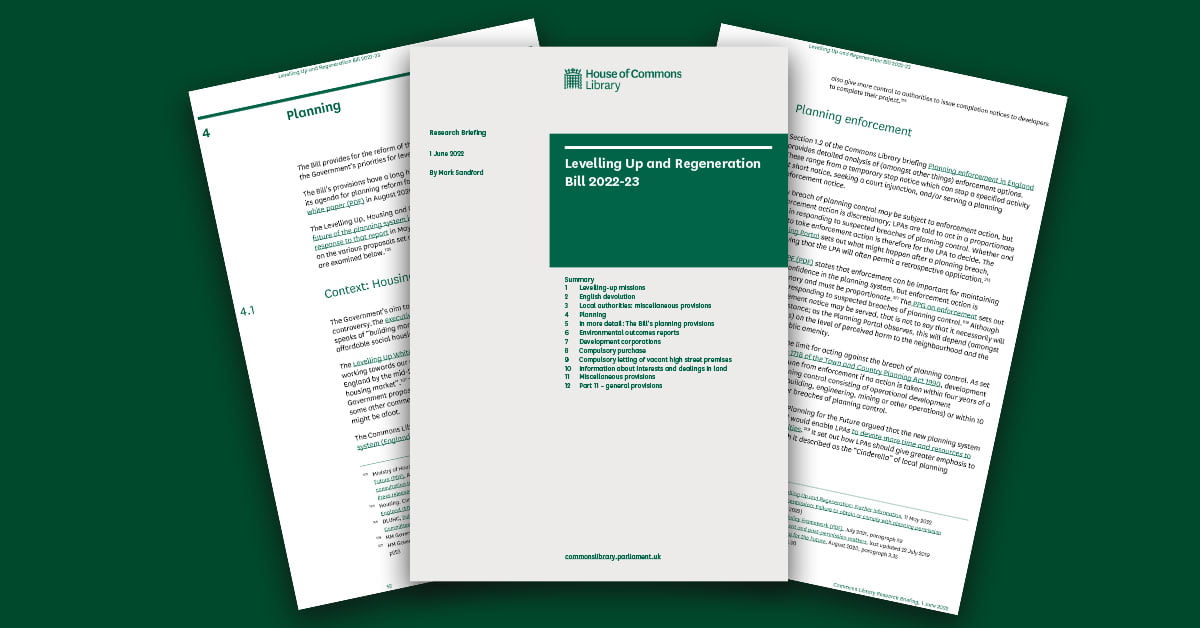
The government’s Levelling Up and Regeneration Bill saw its first reading on 11th May 2022. Touted as a ‘key component’ to reducing inequality and closing the UK’s wealth gap, the proposals contained in the Bill include various changes to the planning system.

The Bill extends to 326 pages, so Jasmine Philpott, Planner at Durrants, has attempted to summarise the proposals that could have the biggest impact on our clients.

Planning fee increase

A planning fee increase of 35% for major applications and 25% for minor applications is proposed – that means an increase from £462 + VAT to £578 + VAT for most applications. The extra revenue is intended to improve the service for applicants and the level of skill within local authorities, which can only be a good thing, but such big increases are a difficult pill to swallow in the midst of a cost of living crisis. 

Another change is the extension of the period for taking enforcement action to 10 years in all cases (it is currently 4 in some cases). This means a longer wait for Certificates of Lawfulness for some uses, and a higher risk of enforcement action.

Replacement of CIL

The government are now proposing to replace CIL (Community Infrastructure Levy) with a new levy (just ‘Infrastructure Levy’), which will be calculated on uplift in value rather than floor space. It appears that through the new levy, if, for example, build costs increase and property prices go down over time, the Levy payable would reduce to reflect that. But it will also work the opposite way, so that if your scheme grows in profit, you will pay more Levy.

And if you thought this will finally mark the end of Section 106 agreements, think again – those are here to stay.

What now?

The Bill is only at the first reading stage, and accompanying regulations and guidance have yet to be published. The Bill requires three readings in the House of Commons, and three in the House of Lords, then it receives Royal Assent, with amendments made throughout that process. The changes therefore will not take effect until at least 2024, and there is every chance that the Bill could look very different by then.

Posted on

From concept to completion – Durrants Building Consultancy

durrants building consultancy

Durrants are renowned for providing expert advice when buying or selling your home, but we are also behind many successful new build and renovation projects managed by our expert team at Durrants Building Consultancy.

Whether you have plans for a barn conversion, minor residential development or larger scale projects on existing land, we can advise you on the whole process including site appraisals and planning through to architectural design.

Jasmine Philpott, Planner at Durrants Building Consultancy, believes our in-house experience and capabilities make us the obvious choice when looking for a company to work with on your next project. She says: “Our key advantage is that we have architects in-house working alongside the two planners on the team. We all look at drawings together to give a fully cohesive approach to a project.

“Alongside that, the experience available within the team of both the market and the local area is second to none. We have the capability to advise and manage anything from a single house extension to promoting a site for a large-scale housing development.”

Jonny Rankin, Principal Planner adds: “I’ve worked for, and with, local authorities across East Anglia and our decades of experience in that area gives us an excellent working knowledge, so we work with Planners and Conservation Officers to achieve successful outcomes for clients.”

The team has experience in working on as many as 50 new dwellings in a large development but Durrants also often works with private individuals who are potentially looking to sell an existing piece of land or who need advice on how to convert an outbuilding.

It is the variety of different projects that Jasmine says makes her role exciting. “It sounds a bit like a cliché, but you really are changing people’s lives. If a client has had a barn in their garden for years and didn’t know what to do with it and you’re able to get them planning permission, it’s quite life changing. They can decide to create a holiday home to rent out or sell it and use the money as they wish.”

The friendly team at Durrants Building Consultancy are always happy to discuss your plans and help you get your project off the ground. There is more information about our services here, but please get in touch with our Building Consultancy team to find out more on 01379 646603.