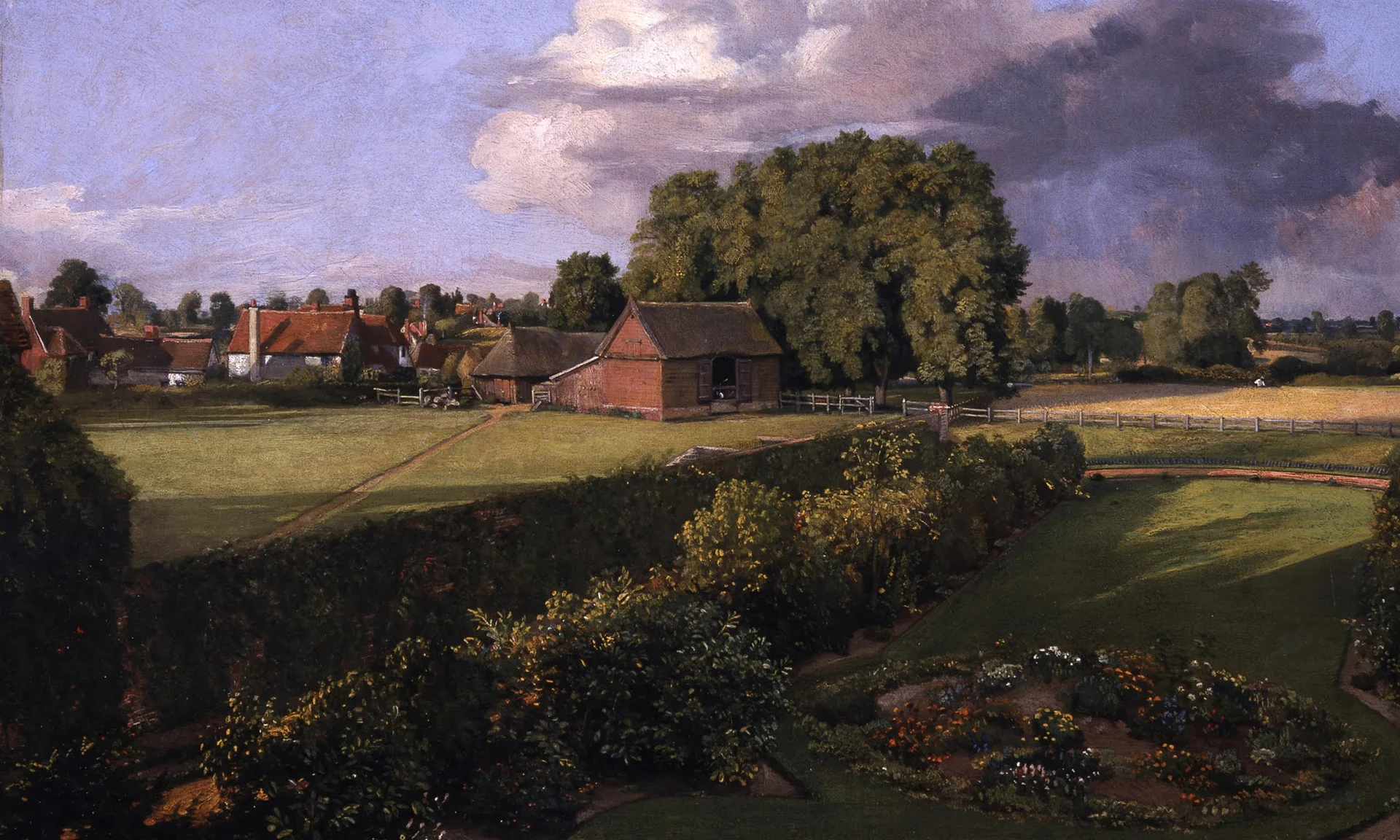
John Constable’s ‘Golding Constable’s Flower Garden’, 1815.
In East Anglia, we are fortunate to benefit from an abundance of traditional farm buildings, most of which are built from either traditional red brick (as well as flint and clay lump) or of a timber frame with wooden cladding.
And just as ubiquitous as the barns themselves is their colour. They are almost invariably black. After all, that is the traditional colour for a timber-clad historic barn, right?
The practice of painting barns black became commonplace in the 1830s, and the black was not paint, but tar, which had protective qualities, preventing rot and damage from insects and water. But before then, timber stains were likely oil-based, probably using linseed oil and various oxides to create a pigment.
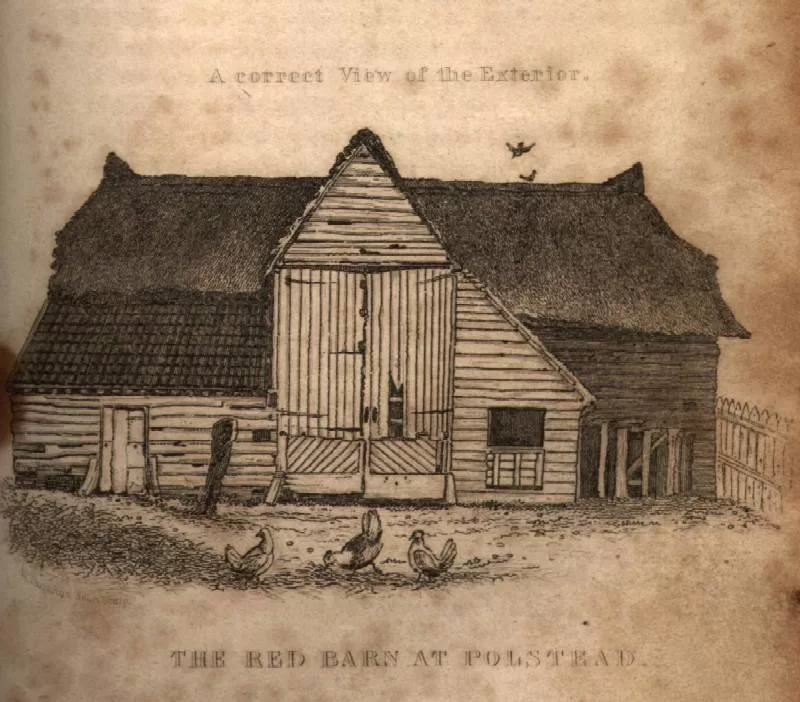
The Red Barn at Polstead
Red was particularly common, and this is evident from paintings and stories from the time. Constable’s ‘Golding Constable’s Flower Garden’ painting (1815) shows a thatched, timber-clad barn painted ochre for example. The famous ‘Red Barn Murder’ of 1827 took place in a barn in Polstead, often mistakenly assumed to be so named because of a small part of its roof being red clay tiled, but it is more plausible that this barn was painted red.
The use of red paint was logical given that it was likely made using linseed oil and iron oxide (i.e. rust powder) both of which would have been readily available on farms at the time. Barns in the USA are still predominantly red, and it is possible that the tradition of using linseed oil and iron oxide was exported from Europe.
Evidence of earlier paints on South Norfolk barn. Image: Jasmine Philpott
There are also examples of weatherboarding being painted white or cream. This would have been achieved wither through distemper (mixing ground chalk with size, a weak glue and water), or mixing slaked lime and water to make a limewash. Pigments could then be mixed with these to achieve a red or yellow ochre. Remnants of both red and yellow paints can be seen on a barn in South Norfolk as evidence of this.
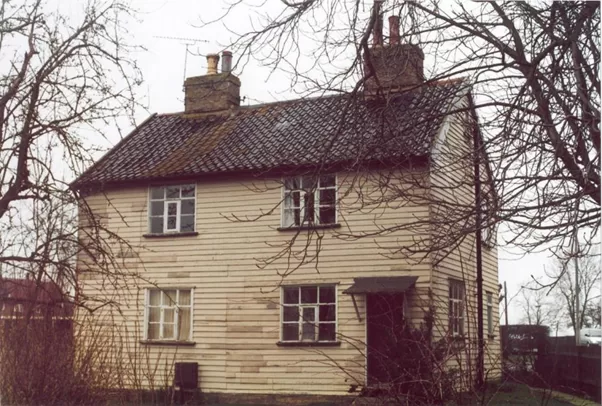
Though not a barn, White Cottage in the grounds of Framlingham College was the only remaining example of a weatherboarded dwelling in East Suffolk until its rather disappointing demolition in 2023. Outside of East Anglia, the Grade II Listed White Barn at Great Dixter House and Gardens in East Sussex dates from the early 18th century and is believed to have always been white.
It is also very plausible that barns would not have been painted at all. There are numerous examples of unpainted weatherboarding to barns. Unpigmented linseed oil may have been used in these cases – indeed, this is still used for exterior garden furniture for example.
The White Cottage in the grounds of Framlingham College, now demolished following a fire (Image: Timothy Eason)
Unfortunately, the common assumption that barns should be painted black is well embedded, and it is likely that a compelling justification would be needed to choose a different colour, if a planning application or listed building consent is required. A 1994 planning appeal relating to a barn that had been painted white as part of a residential conversion concluded that ‘Suffolk barns must remain black’. Literature on the subject is fairly limited, and because the use of tar pre-dated the advent of photography, evidence of earlier pigments is only found through remnants of paints on buildings themselves, paintings and anecdotal evidence.
This is not a call to move away from painting barns black altogether, rather an appeal for deeper consideration before assuming that black is the appropriate choice. After all, we paint our homes a variety of colours, why not re-introduce that diversity into our outbuildings?
West Suffolk District Council has confirmed that their new Local Plan has been adopted, and will now be used to determine planning applications in the District between now and 2041.
The Plan makes provision for 13,005 new homes and 85 hectares of land for employment growth.
Readers may be aware that the government recently introduced a new methodology for calculating housing need for local authorities. These changes have meant that West Suffolk will immediately start a review of their Local Plan using the new, higher housing need figure.
The policies in the Plan remain similar to those in the previous document. One change of particular interest to our readers is the rural infill policy, SP21, which allows the infilling of a gap within a group of seven or more existing dwellings. In the previous Plan, this was a minimum of ten, and this reduction is welcomed, though a requirement for the settlement to have access to public transport links has been added, and this will present challenges in rural areas.
The Plan includes a policy allowing the conversion of redundant rural buildings to dwellings, but requires 12 months of marketing to demonstrate that employment, economic development, tourism, recreation and community uses have all been ruled out. This is more onerous than similar policies in neighbouring authorities, which usually only require the building to be of architectural merit or the conversion to constitute an improvement in the appearance of the building.
The remaining policies are reasonably standard, though there is a definite focus on green infrastructure and sustainability in this Plan.
Durrants’ Jasmine Philpott, Senior Planner and Development Surveyor, comments on BNG introduced in 2024 and how it has created major challenges for small developers due to unclear guidance, costly rules and limited support – prompting calls for a simpler and fairer system.
When Biodiversity Net Gain (BNG) was introduced in May 2024, it was done so with little guidance or training on how to apply it, and apparently little consideration for the practicalities of delivering it. BNG requires all planning applications to demonstrate a 10% improvement in biodiversity post-development compared to pre-development. It currently applies to almost all planning applications of more than 5m x 5m in area, and requires an on-site ecology survey, the completion of a government-issued metric, and a plan for how the 10% will be achieved.
The biggest issue with BNG that we have encountered is the restrictive rules around on-site versus off-site gain. Current regulations do not allow the 10% gain to be provided within residential garden land, so any owner of a prospective residential development has to either provide off-site solutions on land they own in the area, or purchase credits. An added complication is that off-site solutions require a Section 106 agreement, which take months to agree and hundreds or thousands of pounds in legal fees.
The second issue is that there are not enough consultants, or capacity at local authorities, to process all of this additional work. The entire industry appears to be muddling along and doing everything they can to justify an exemption to avoid BNG altogether. As usual with these types of well-intended but poorly considered schemes, BNG favours large scale developers and big landowners, who have the space to provide on-site BNG outside of gardens, or own spare land and have the in-house expertise and funding to push through the S106 process. This inequity should also be considered in the context of the huge decline in the number of small and medium size developers (SMEs) in the industry – from SMEs obtaining 21% of all planning permissions in 2010-11 to just 9.3% last year.
The government appears to recognise this problem, and it was very welcome news to hear that the government are consulting on a radical overhaul of the BNG regulations to lift the burden on SMEs. I have read and commented on the consultation and thought that almost all of the suggestions were very sensible.
They include a complete exemption from BNG for ‘very small sites’ and a streamlined BNG process for ‘small sites’ (less than 9 homes) and ‘medium sites’ (10 to 49 homes). There is discussion on introducing a standard S106 agreement to avoid inconsistences between law firms and local authorities, and introducing a simplified metric that does not require input from an ecologist.
I was particularly pleased to see mention of stricter validation requirements and measures, as well as plans to reduce the number of planning applications determined by planning committee – something I have advocated for in previous columns (clearly Angela Rayner reads the Diss Express and my articles on the Durrants website).
I appreciate that nature lovers among us (and I consider myself one) may consider this to be a backwards step – the Wildlife Trust are certainly not happy to see BNG being ‘watered down’ so soon after it was launched. However, there is a balance to be struck when it comes to nature and development. If nature protection and enhancement becomes too onerous, it turns developers and the public against it and can lead to attempts to sabotage and destroy habitats to make the process easier. I have always felt, and many of my ecology consultant contacts agree, that small pockets of BNG land scattered across the country are far less effective than large-scale areas set aside for nature. I would therefore like to see governments and business setting up more BNG sites, with smaller developers simply making a financial contribution to these schemes. It does appear that this is the direction that BNG will take in the future, and I think this is a good thing.
This article was first published in the Diss Express.
Durrants’ Jasmine Philpott, Senior Planner and Development Surveyor, comments on the most frequently asked planning questions, offering practical advice to landowners and homeowners.
I’ve opted for a slightly different approach to the column this month. Rather than share my thoughts on the implications of wider political changes on the local development landscape, I thought I would share 6 of the most frequently asked planning questions I get as a planner, and attempt some relatively straightforward answers.
Do I need planning permission…
1…to put a static caravan on my land?
It depends on the use of the land and the caravan. If the land is residential garden land, caravans can be placed in the garden without planning permission if they are used for purposes ‘incidental to the enjoyment of the main dwelling’. If it is to be used as an annexe for example, it will need planning permission.
For agricultural and equestrian land, planning permission is generally needed to place a static caravan. There are permitted development rights for temporary structures, but these are for temporary uses, such as construction work or a one-off event.
2…to paint my house?
Unless it is listed, no. Technically painting a listed building requires Listed Building Consent, but normally an informal exchange of emails with the local Council will suffice.
3…to host an event on my land?
Land can be used for pretty much anything as long as it is for less than 28 days per calendar year. If you are holding a market or a motor event (including practise days), it is a maximum of 14 days per calendar year. The event cannot be within a building or the curtilage (vicinity) of a building, and cannot be within a Site of Special Scientific Interest if the event is for motorsport, clay pigeon shooting or war games. Camping is also prohibited, unless it is in connection with a festival.
However, a separate part of legislation allows for recreational camping without planning permission for up to 50 pitches and any moveable structure reasonably necessary for the campsite for up to 60 calendar days per year. Planning permission is not needed, but you do need to notify the local authority.
4…to create a new vehicular access?
Yes, if it is an entirely new access. You will also normally need a Dropped Kerb licence from the county highways authority. If you have an existing access that needs to be improved or formalised, you may only need the Dropped Kerb licence and not planning permission, but it depends on the circumstances.
5… to demolish a house and replace it with more dwellings?
This depends on the relevant local authority’s policy on replacement dwellings. Replacing existing dwellings is usually not contentious, providing the replacement is similar in scale to the original dwelling, but increasing the number of dwellings can be an issue, especially in a rural area.
6…to build an agricultural barn?
If your agricultural unit extends to more than 5 hectares (12.4 acres), you should be able to build an agricultural barn under permitted development rights, meaning you can avoid a full planning application. However, a Prior Approval application (a mini planning application) is still required, and be aware that if you go ahead without seeking prior approval first, it cannot be obtained retrospectively, so you will have to apply for retrospective planning permission. Agricultural barns are usually subject to CIL as well, so think carefully before going ahead! If your unit is less than 5 hectares, you will need full planning permission. There are also restrictions in relation to the use of the building and its proximity to dwellings which should be considered.
This article was first published in the Diss Express.
To say that 2025 has been dramatic (by planning standards) would be an understatement. The government’s overhaul of the planning system is really starting to manifest on the ground thanks to the previous changes to the National Planning Policy Framework (NPPF) and the emerging Planning & Infrastructure Bill (PIB) and Levelling Up and Regeneration Bill (LURB).
Here is a round up of the latest changes and how they are affecting Norfolk and Suffolk.
5-year land supply (5YHLS) and the ‘tilted balance’
It has been the case for many years that all local authorities must be able to demonstrate that they have planned for at least 5 years of housing growth in their area. How important this is, and how the 5 years is calculated, has been tweaked over the years, but the recent overhaul has seen a new methodology for calculating land supply that factors in affordability of the area as well as previous under-delivery. The result is that many local authorities now cannot demonstrate the 5 years, when they could under the previous government and methodology.
Almost every local authority in Norfolk and Suffolk has now confirmed they cannot demonstrate a 5YHLS:
East Suffolk (Waveney only)
West Suffolk
Mid Suffolk
Greater Norwich – including South Norfolk and Broadland
Kings Lynn & West Norfolk
Breckland
North Norfolk
Without a 5 YHLS, the ‘tilted balance’ applies. This is where Councils must approve planning applications for new homes unless the adverse impacts of doing so would ‘significantly and demonstrably outweigh the benefits’. Also called the ‘presumption in favour of sustainable development’, this situation effectively renders any existing planning policies nul and void.
In practice, this means that planning applications that would normally be refused may be granted planning permission if a local authority cannot demonstrate a 5YHLS. However, it is important to note that the scheme must still not cause any unacceptable harm, so if a proposal has poor vehicular access, or would harm a listed building, have flooding issues etc, it will likely still be refused regardless of the land supply position.
Local authorities are now making plans to rectify their under-supply, which will take months or even years for many of them, and the ‘tilted balance’ applies until the 5 years can be demonstrated.
While this is an opportunity for those wishing to develop their land, it is understandably cause for concern for others, particularly in rural areas. Delivering 1.5 million homes will result in significant changes to all parts of the country. But recent case law has shown that heritage, environment, access etc are still valid reasons to refuse an application, even in areas of under-supply.
Nutrient neutrality and an Environmental Delivery Plan
Nutrient neutrality has now been affecting most of Norfolk for over 3 years, stalling development in the area. The PIB has introduced a Nature Restoration Levy, which is a government-led system where developers pay a levy which funds a large-scale mitigation scheme to mitigate nutrient impacts. This is very welcome news, as on-site nutrient neutrality mitigation is very difficult to achieve. However, it will take time to come into force – likely between 6 months and a year. Note, this will not be able to be used for Biodiversity Net Gain.
Planning committees
The PIB seeks to improve the planning committee process, by introducing mandatory training for all committee members, for which certificates will be issued on completion. There are also proposals to bring in separate committees dedicated to strategic decisions, and to bring in a national scheme of delegation, which sets out the ‘triggers’ for an application to go to committee.
Statutory consultees
Statutory consultees are parties whom it is mandatory to consult with on a planning application. Examples include the local flood authority, parish or town council, county highways and the historic environment team for works to heritage assets. Currently, all consultees have a deadline by which to respond to an application, but in practice, some miss the deadline, leaving the case officer unable to issue a decision. The proposed changes would reduce the number of statutory consultees and provide case officers with more freedom to determine an application without their comment if they have missed their deadline.
This is a particularly welcome change, as though on the whole, consultees meet their deadline, it is not uncommon for comments received weeks after the deadline to be taken into account and cause last minute problems.
Increasing planning application fees
Application fees already went up in 2023, but are increasing again as of 1st April 2025. This has unfortunately coincided with an increase in the admin fee charged by the Planning Portal (through which all applications must be made). All fees are increasing by 1.7%, and will increase each year in line with inflation. Fees are also being increased fir specific application types, with Section 73 applications now carrying three separate fees according to the type of development. Householder applications are increasing from £258 to £528 for a single dwelling and from £509 to £1,043 for two or more. Fees for minor works within the curtilage of a dwelling are not changing. Prior approval applications are doubling.
Compulsory purchase
There was panic in the farming community in particular when news circulated of proposed greater use of compulsory purchase rights, whereby the government can acquire land by force in order to release it for development. However, to provide some reassurance, the aim of this appears to be to unlock otherwise stalled developments for infrastructure, schools and housing where land assembly is preventing development from going ahead.
Our view
The government have acted quickly to make sure their changes have an impact within their term. It is quite an exciting time to be working in planning, and certainly a positive climate for those working in development. Of course, a potential influx of development land coming to the market may negatively impact land values, but developers are always looking for sites, and the changes should provide more land for small and medium sized housebuilders, which is positive.
The proposed changes to the planning committee process and statutory consultee role are very welcome, and though the planning application fee increase will be hard to stomach for small applications, providing it results in a better planning service, I feel it will be worth it.
We certainly appear to be in a pro-development world, but whether this filters down to planning officers and validation teams remains to be seen. I predict plenty of planning by appeal over the next few months!
Durrants Jasmine Philpott, Senior Planner and Development Surveyor looks at government planning reforms taking place this Spring.
Secretary of State for Environment, Food and Rural Affairs Steve Reed confirmed that the government will be consulting on planning reforms to encourage farm diversification in the Spring.
This is welcome news in the wake of recent planning reforms, which have been largely focussed on the delivery of housing, with little mention of farming or rural development.
Further detail has yet to be released, but Mr Reed stated in a speech at the Oxford Farming Conference that the reforms will make it ‘quicker for farmers to build farm buildings, barns and other infrastructure they need to boost their food production’. This appears to include expanding permitted development rights to enable larger barns to be converted into a farm shop, holiday let or sports facility. The current regulations allow for up to 1,000sqm across a holding to change to a flexible commercial use, but this does not currently include holiday lets, which would need full planning permission. Mr Reed appeared to also allude to greater permitted development rights for constructing new buildings.
Readers will recall that last year saw the expansion and relaxation of permitted development rights for farmers, with more options for converting buildings to residential and commercial uses, though little had changed with regards to new agricultural buildings.
We look forward to seeing draft legislation in the Spring, and will report back in detail when it is released.
Durrants Jasmine Philpott, Senior Planner and Development Surveyor comments on the updated NPPF which focuses on sustainable development with stricter housing need calculations and measures to boost housing delivery across the UK.
New Year, new planning framework
Many of us will have read the headlines regarding the new government’s promise to reform the planning system in order to build 300,000 homes a year.
As part of this, the government published a new National Planning Policy Framework (NPPF) on 12 December 2024, following a consultation this Spring (see our earlier article – Three big changes in planning and how they could affect you). The NPPF is the starting point for all planning decisions and local plans, and sets out strategic policies which guide priorities and principles for decision making across the country.
Planning applications are ultimately determined in accordance with each area’s local plan, but the NPPF guides how local plans should be created, what they should contain, and provides a fall-back set of policies where a local plan is either silent or irrelevant. The NPPF also dictates how housing need should be calculated for each region, and it is this area that has seen the most change in the new Framework.
The overall message of the NPPF remains unchanged: to achieve sustainable development. However, this version is more pro-development, with an emphasis on local authorities delivering more housing and more infrastructure.
So, what are the key changes, and how will they affect the planning system in Norfolk and Suffolk?
A new housing need calculation
All local authorities (LPAs) must be able to demonstrate that they have a 5-year supply of land for housing (5YHLS), plus a buffer of 5% as a contingency. Under the new NPPF, LPAs must be able to demonstrate this every single year – it is no longer enough to refer to the 5YHLS that was set out in their local plan.
Crucially, the methodology for calculating housing need has changed, and all LPAs must use the new standard methodology. The calculation is now based on a minimum of 0.8% of existing housing stock in the area, and the less affordable the area is, the higher the percentage of growth must be. Affordability is based on the ratio of median house prices in proportion to median incomes. As an example, in an area where this ratio is 9:1, the growth number would be 1.76% per year.
Once this need figure is calculated, the LPA must then convert this into a housing requirement, which also factors in the needs of specific groups, such as the elderly, students, those with disabilities and of course, affordable housing.
It should be noted that local authorities whose local plans are in advanced stages of preparation can avoid these new measures.
New sanctions for under performance
In addition to this new metric for calculating housing need, the government has introduced measures to incentivise authorities to perform. Where an LPA’s housing delivery has fallen below 95% of their requirement over the previous three years, the must prepare an action plan to identify how delivery will be increased. Where delivery has fallen below 85%, the LPA must prepare an action plan, and add a buffer of 20% to their housing requirement. And if delivery falls below 75%, an action plan must be prepared, with the 20% buffer included, but importantly, the ‘presumption in favour’ applies, explained below.
The presumption in favour of sustainable development effectively means that where an LPA has under-delivered housing as set out above, their local plan policies are deemed to be nul and void, and planning applications should be approved unless significant adverse impacts of doing so can be identified. The local plan polices in question could for example be those requiring barns to be of historic or architectural merit to qualify for conversion, those restricting rural housing developments to either affordable-led or infill schemes, those restricting the expansion of intensive poultry sites, or even housing allocations which include a cap on the total number of homes acceptable. This means that in local authority areas where there has been a pattern of under-delivery, planning applications that would normally be refused could be approved either by the authority, or if needed, at appeal.
What this means for your site
In reality, the changes will not have an immediate effect on planning in most areas. We expect local authorities to confirm their positions over the coming months, as they come to terms with the new methodology and work out what action they need to take.
As a general rule, local authorities in Norfolk and Suffolk rarely feature in the worst performing ones across the country, so we are not expecting the presumption in favour to apply to many in our area. However, for those currently preparing a local plan (which includes Mid Suffolk, Breckland, North Norfolk and West Suffolk), it is possible that they will now need to plan for more housing than they would have done before. This means that if you have a site with long-term planning potential, you should consider instructing an agent (such as us) to assist you in promoting it when the opportunity arises.
In areas where the presumption in favour does apply and/or there is no 5YHLS, this could mean that you could make a speculative application at risk and gain an approval where you would not have previously.
Are any local areas affected by this?
So far:
∙Breckland have admitted in a recent decision notice that they cannot demonstrate a 5YHLS.
∙Mid Suffolk have confirmed they will have to start again with their local plan in order to meet the new requirements.
∙Kings Lynn and West Norfolk do not have the required housing supply and the ‘presumption in favour’ applies there
∙Great Yarmouth are seemingly rushing to get their draft local plan submitted before March so that they avoid these new measures.
My opinion
We knew that change was afoot when Labour were elected, and changes made to the NPPF by the Conservative government just before the election were widely criticised at the time. It is no surprise that the onus is on local authorities to lead the charge in delivering more housing, and the NPPF goes as far as it reasonably can in this regard.
However, anyone working in the planning system on a daily basis will know that the causes for delay and under-delivery run far deeper than the changes made to the NPPF can reach.
The ever-increasing amount of information which needs to accompany an application to even make it valid is one such example, the most recent being Biodiversity Net Gain. The requirements for even basic ecology surveys have become more onerous (and therefore expensive), and many parts of the country are in the Nutrient Neutrality (NN) catchment, where development has completely halted. The government has not found a solution to this yet, and arguably needs to if they are expecting local authorities within the NN catchment to deliver the housing growth that they are demanding.
Similarly, the burden of unnecessarily onerous planning conditions is often overlooked – many of these need to be addressed before work can even start. The abuse of extensions of time, the ability for LPAs to set their own validation lists, and the influence of local politics are just some of the causes of delay in the planning process that these changes to the NPPF will not address.
Durrants Jasmine Philpott, Senior Planner and Development Surveyor describes a South Norfolk Class Q appeal success story.
Durrants and a longstanding client are celebrating this week after a Class Q application on a redundant farm near Harleston were overturned by the Planning Inspectorate, despite being refused twice by the Council.
18 months after the first Class Q application was refused, PINS allowed the appeal and awarded costs against South Norfolk Council for their unreasonable behaviour during the appeal.
The background
Class Q allows for the change of use of an agricultural building to one or more dwellings. Class Q legislation is more restrictive than planning policy, but is generally also less subjective, meaning it is usually easier to predict whether an application will succeed.
The barn in question was surrounded by numerous redundant farm buildings owned by the applicant. They were empty at the time the application was made. Another agricultural building in separate ownership was located around 40m from the application site. As part of the first application, Durrants showed the redundant buildings to be demolished on plan, and suggested that their demolition could be conditioned as part of the planning approval. This was standard practice in South Norfolk previously, and Durrants had made numerous applications in which buildings outside of the application area were conditioned for demolition in this way.
The refusal
The first Class Q application was unexpectedly refused, as the Council was of the opinion that it was not possible to impose planning conditions on Class Q approvals anymore, and that the buildings would need to be demolished before a new application is made.
As many readers will appreciate, demolishing buildings can be very costly, and would have been a risky course of action given that there was a chance that a subsequent application might be refused.
The Council were also of the view that the neighbouring barn outside the applicant’s ownership could be intensified in use, in a way that could result in noise, odour and insects disturbing future occupants.
Durrants resubmitted the application, supported by noise and odour reports from independent consultants, both of which found that the risk of any disturbance in these regards was low. Alterations were also made to the design to provide additional mitigation against these risks. The Council’s Environmental Protection Officer (EPO) had no objection to the application. The Council however refused the application for a second time despite the findings of the reports and their EPO.
The appeal
An appeal was subsequently lodged. During the appeal, the Council conceded that their position on the ability to place conditions on prior approvals was wrong. Half of their reason for refusal thus fell away.
The Inspector ultimately allowed the appeal, citing the noise and odour reports, the lack of objection from the EPO and the reality that future residents of a rural area will reasonably expect a degree of disturbance from agricultural activities as reasons for her conclusion. She also agreed with Durrants’ argument that the barn outside of the applicant’s ownership was too small to ever be used intensively.
This appeal was a huge win for us and our client, and set an important precedent on this issue that will be useful for future Class Q applicants in South Norfolk and elsewhere.
This article first appeared in the Diss Express, published 13th December 2024.
Durrants Jasmine Philpott, Senior Planner and Development Surveyor looks at affordable housing and discusses why it is such a political hot potato.
In my experience, ‘affordable housing’ is a largely misunderstood term, despite being one of the most talked about topics in political discourse, particularly under the new government.
It is widely known that there is a housing shortage in this country, with a particularly acute need for affordable housing. But what exactly does ‘affordable’ mean, and why are we still struggling to deliver enough affordable homes?
Affordable housing is effectively today’s label for social housing (previously council housing). Unlike market housing, affordable housing is built specifically for those who are on the local authority’s housing waiting list because they cannot afford to rent or buy at market prices.
Affordable housing takes many forms, including social rent (the cheapest form of rent for those on very low incomes), affordable rent (up to 80% of market rent), and shared ownership (where only part of the property is purchased and the rest remains the ownership of the social housing provider).
The key difference between today’s affordable housing and the council housing built before the 1980s is that now, affordable housing is generally not delivered by local authorities. It is almost always owned and managed by Registered Providers (RPs). These are not-for-profit organisations which were set up when social housing was privatised in the 1980s. Some RPs build their own affordable homes, but many of them bid for affordable housing that is part of private-led housing schemes built out by private developers. In this situation, the RP purchases the homes at a percentage of market value, the developer builds them to the RP’s specification, and the RP takes ownership of them once completed, managing them under one of the various tenures listed above.
RPs receive some government funding, but this has been cut in recent years, meaning many of them have set up private development arms to fund their affordable element, which can also allow them to access funding from Homes England. An example of this is Clarion, the largest affordable housing provider in the UK, whose private development arm, Latimer, reinvests all of its profits into Clarion.
As you can imagine, this system is flawed, because it largely relies on private developers to deliver affordable housing, which is often unviable by the time ever-increasing build costs, land values and other costs like CIL, Section 106, biodiversity net gain etc are factored into the scheme. This then means that developers are forced to try to negotiate less affordable housing with the Council.
By comparison, in the 30 years following WWII, more than 100,000 social homes were built per year in England. Social housing made up a quarter of all UK homes by the 1960s. In 2018, just 7,000 were built. Right to Buy in the 1980s gave many people the chance to buy their Council house at a reduced price, but around 175,000 council homes were purchased every year throughout the 1980s under Right to Buy (over 4 million in total), and never replaced.
With around 1.2 million households on the waiting list (and 12,000 in Norfolk), it is easy to see the extent of the shortage and why this subject is inevitably a priority for government. However, some good news is that since the all time low of 2018, last year saw 63,605 affordable homes delivered in the UK. And in our area, Station View, Diss is a 100% affordable scheme, with others underway across South Norfolk.
It should be noted that councils often exercised their powers to compulsory purchase the land needed to deliver social housing during that era, which would be very unpopular today. Planning was also alot more straightforward then, with biodiversity, climate change or even location seemingly of little concern compared to now. So while tempting to yearn for a return of the pre-1980s social housing model, it was certainly not without its flaws.