Posted on

The Renters’ Rights Act Explained: What Landlords Need to Know

The private rented sector is undergoing one of the most significant reforms in a generation. The Renters’ Rights Act marks a decisive shift in how tenancies are structured, how properties are managed and how landlords demonstrate compliance. While much of the public discussion has focused on tenant protections, the Act also sets out a clearer, more regulated framework for landlords who operate professionally and plan ahead.

For landlords, understanding the intent of the legislation and preparing early is essential. At Durrants, we work closely with landlords across Norfolk and Suffolk to help them adapt confidently, remain compliant and continue to protect the long-term value of their property investments.

Why the Renters’ Rights Act has been introduced

The Renters’ Rights Act has been introduced to address long-standing concerns around security, standards and fairness in the private rented sector. Over recent years, renting has become a long-term housing solution for many households, rather than a short-term stepping stone. The legislation reflects this reality by aiming to provide greater stability for tenants while improving consistency and professionalism across the sector.

Key objectives of the Act include:

  • Increasing security of tenure for tenants
  • Improving property standards and enforcement
  • Creating clearer, more transparent processes for rent increases and possession
  • Raising overall confidence in the private rented sector

For landlords, this represents a move away from informal practices towards a more structured and evidence-based approach to letting property.

Changes to tenancy structure and tenure

One of the most fundamental changes is the removal of fixed-term Assured Shorthold Tenancies. Under the new framework, all tenancies will become open-ended periodic tenancies by default. This means landlords can no longer rely on the expiry of a fixed term as a natural breakpoint.

While this increases flexibility for tenants, it also places greater importance on ongoing tenancy management. Landlords must ensure that properties remain compliant throughout the tenancy and that communication with tenants is clear, professional and well documented.

The abolition of Section 21 and changes to possession

The removal of Section 21 ‘no-fault’ evictions has been one of the most widely discussed aspects of the Renters’ Rights Act. Once fully implemented, landlords will no longer be able to regain possession without providing a legally defined reason.

Instead, all possession claims will be made using Section 8 grounds. These grounds have been strengthened and expanded to give landlords clarity around legitimate reasons for possession, such as:

  • Intending to sell the property
  • Serious or persistent rent arrears
  • Anti-social or criminal behaviour
  • Breach of tenancy obligations

However, possession is no longer automatic. Landlords must follow the correct legal process, serve valid notices and provide appropriate evidence to support their claim. Errors in documentation or procedure can result in significant delays.

Higher standards and compliance expectations

Alongside changes to tenure and possession, the Act introduces stronger expectations around property standards and compliance. This includes closer alignment with existing safety and fitness requirements and the extension of new measures, such as Awaab’s Law, into the private rented sector.

Landlords will be expected to:

  • Address serious hazards, including damp and mould, within defined timescales
  • Keep accurate records of inspections, repairs and communications
  • Comply with updated rules on rent reviews and rent increase notices

In addition, the introduction of a mandatory Private Rented Sector Ombudsman will give tenants a clear route to escalate complaints, increasing the importance of robust internal processes and professional management.

What this means for landlords in practice

The direction of travel is clear: the private rented sector is becoming more regulated, more transparent and more accountable. For landlords who already manage their properties well, the Renters’ Rights Act formalises good practice. For others, it represents a need to reassess how their portfolio is managed.

Key risks for landlords include:

  • Using incorrect notices or outdated tenancy agreements
  • Poor record keeping or informal arrangements
  • Delays in addressing maintenance or safety issues

Equally, there are opportunities for landlords who take a proactive approach to compliance and professionalism.

How Durrants helps landlords stay compliant and protect their investment

At Durrants, we understand that legislation can feel complex and time-consuming, particularly for landlords balancing property with other commitments. Our experienced lettings team provides practical, up-to-date advice tailored to each property and tenancy.

We support landlords by:

  • Reviewing tenancy agreements and advising on transition to periodic tenancies
  • Managing rent reviews and serving compliant notices
  • Providing guidance on possession grounds and processes
  • Coordinating inspections, maintenance and safety compliance
  • Acting as a professional buffer between landlord and tenant

Our aim is not only to help landlords meet their legal obligations, but to protect rental income, minimise risk and maintain positive, long-term tenancies.

Looking ahead

The Renters’ Rights Act represents a new era for the private rented sector. While change can feel daunting, it also offers clarity and structure for landlords who are willing to adapt. With the right advice and professional support, landlords can continue to invest with confidence.

If you would like to discuss how the Renters’ Rights Act affects your property, or how Durrants can support you through the changes, our lettings team is here to help.

Posted on

Supporting Our Community: £1,000 Donation to Feed All Children

Lily presents a cheque to 'Feed All Children' from the Durrants Charitable Foundation.

At Durrants, supporting our local community is central to who we are and what we stand for. That’s why we’re proud to share that we have donated £1,000 to the Feed All Children initiative from the Durrants Charitable Foundation.

On 16 December 2025, Maddy Durrant and Sarah Jerman were pleased to receive the cheque from Lily Lawrence, Residential Sales Manager at our Southwold branch, on behalf of the project. The moment reflected a shared commitment to helping local children and families during a particularly challenging time.

About Feed All Children

Feed All Children is a project run by Sole Bay Care Fund, a local community charity that works closely with schools, community organisations and support groups to help those in need across the Sole Bay area.

The aim of the project is simple but powerful: to ensure that every child at local primary schools can access a nutritious meal each day. While many children already qualify for free school meals, local schools have a higher-than-average uptake compared to national figures. In the current economic climate, many more families are facing financial pressures that can make providing regular meals a real challenge.

Research linked to the project has shown that when families are struggling, both children and parents may go without food. Feed All Children helps to remove this burden by offering meals to all pupils, ensuring equality, reducing stigma and supporting families who may otherwise fall just outside traditional eligibility criteria. Parents can choose whether to take up the meal or continue paying, preserving dignity and choice.

Making a real difference

Currently operating as a pilot project across several local primary schools for the winter term, Feed All Children is already having a significant impact. Schools are reporting:

  • Improved attendance
  • Better concentration and engagement in lessons
  • Stronger social interaction
  • Improved overall wellbeing

The benefits extend beyond the classroom. Parents have reported reduced stress and anxiety, with some able to redirect household budgets towards other essentials such as heating. This, in turn, improves family wellbeing and creates a more stable home environm

ent.

A personal connection

The project is especially meaningful for Lily, who attended Reydon Primary School and benefited from a similar scheme during her own childhood. Her involvement highlights just how impactful these initiatives can be, not only in the short term but throughout a child’s life.

We are also proud to support this cause alongside Maddy Durrant, a long-term client of ours, making this donation particularly close to home.

Looking ahead


Following a full evaluation of the pilot, Sole Bay Care Fund hopes to extend Feed All Children to more schools

and over a longer period. Achieving this will require continued fundraising and community support, but the early results clearly demonstrate the value of the project.

As a locally rooted business, we believe in supporting initiatives that strengthen our community from the ground up. Every child deserves the opportunity to learn, grow and thrive and we’re proud to play a part in helping make that possible.

If you’d like to find out more about Feed All Children or support the work of Sole Bay Care Fund, we encourage you to get involved by making a donation via their Peoples Fundraising page or visiting their website for more information.

Posted on

Suffolk councils launch simultaneous Call for Sites consultations

Both East and Mid Suffolk Council have launched new consultations seeking future development land as of 20th October.

East Suffolk District Council, which covers both Waveney and Suffolk Coastal, have recently announced that they are starting a Local Plan review. The Local Plan directs growth in the District, including allocating land for specific uses. East Suffolk currently has two local plans, for Waveney and Suffolk Coastal, adopted in 2019 and 2020 respectively.

From 20th October 2025 until 9th January 2026, landowners are able to put forward their sites for consideration as future allocations for housing or employment uses as part of a Call for Sites exercise. This process, known as land promotion, is usually the only way of obtaining planning permission of any scale, and is a long-term endeavour which may result in land being allocated and therefore suitable for development.

Mid Suffolk (which includes the Babergh area) have also launched a Call for Sites in the same timeframe as part of the preparation of their new local plan.

Durrants are able to submit sites for consideration on behalf of landowners, and would encourage anyone who is interested in doing so to contact buildingconsultancy@durrants.com or 01379 646603 to discuss further. Ideal sites are:

  • Within, adjacent to or close to an existing settlement – i.e. a village, town or city
  • Accessible from a suitable road (or access can be created)
  • Not in a flood risk area
  • Not heavily wooded
  • At least 0.25 hectares or able to accommodate at least 5 homes or 500sqm of employment floor space
Posted on

Planning permissions drop to lowest levels since 1979

New Year New Planning framework

Official data released in September showing that planning permissions for new homes have fallen to a record low under Labour’s government have been described as ‘unacceptable’ by housing secretary Steve Reed.

Approximately 7,000 planning applications for new homes were approved between April and June 2025 – the lowest since records began in 1979 and an 8% fall compared to the same period in 2024. A similar report was released in March 2025, when it was confirmed that just 242,610 homes were approved (not built) in 2024, the lowest since 2014, and that overall, delivery numbers were falling annually.

These trends suggest that the government will struggle to deliver the 1.5 million homes promised in their manifesto, which translates to 325,000 homes per year.

A March report by the Home Builders Federation called for action to increase housing numbers, including more support for first-time buyers, addressing problems in the affordable housing S106 market, increasing resourcing to the planning profession (on the local authority side) and recognising the impacts that tax changes and new policy burdens have on development viability.

The government did fund the hire of 300 new planners, but that only equates to one per local authority area. The autumn budget is predicted to introduce more taxes, including a potential overhaul of stamp duty and council tax which could further impact the development sector. The impending changes to the private rental sector will also affect the buy-to-let market, which makes up 20% of housing stock, with buy-to-let investors accounting for 10% of purchases in 2024, down from 16% in 2015.

But the news isn’t all bad. The figures from the summer show that approvals are up by 2%, with 88% of all applications being approved, and 91% of major applications granted on time. And though the number of residential applications granted was at an all-time low, in fairness to Councils, fewer applications were received in the first place, so the drop in numbers is partially on the applicant side.

The fall in planning permissions is surprising given the tangible changes that the government has made to the planning system, notably the shake-up of 5-year land supply calculations, which has meant nearly every local authority in Norfolk and Suffolk is under-delivering on housing. This opens up opportunities to apply for housing which may not previously have been supported. And yet, numbers are dropping. Why?

I have written before about the burdens of Nutrient Neutrality, Biodiversity Net Gain and the increasingly onerous process of validation delaying the planning process. The latest problem faced in many areas is a lack of capacity for sewage in water recycling centres. All of these play their part in deterring developers from the sector, and all of them have been brought about at a government, national level, not a local one. I cannot help but feel that there are fundamental contradictions (or perhaps ignorance) between the government’s admirable aims and the red tape they continue to do very little to manage or mitigate.

In my role working on rural planning schemes in Norfolk and Suffolk, we have seen people increasingly discouraged from pursuing schemes due to rising build costs combined with the unappealing changes to the private rental sector and the slowing of the residential sales market.

On a positive note though, I feel that we are lucky to have some of the best local authorities in the country in this area, most of whom work proactively with us and are very reasonable and fair. We have enjoyed a 95% success rate with our planning applications in 2025 and though this is in part due to our knowledge of local policy and resulting ability to make applications succeed, some of this has to be credited to local planners.

I was listening to PM on BBC Radio 4 last week, and Victoria Hills, CEO of the RTPI (Royal Town Planning Institute) was asked to give a one-word answer to the question, ‘Will the government deliver 1.5 million homes during its term?’. Her answer was ‘maybe’. I confess that I am less optimistic for reasons of simple maths. With only 200,000 homes completed in year one of Labour’s term, delivery would need to almost double overnight to hit the 1.5m target in the remaining 4 years.

Posted on

The planning matters behind the Epping ‘asylum hotel’ judgments

Asylum hotel article by Jasmine Philpott from Durrants

Durrants’ Jasmine Philpott, Senior Planner and Development Surveyor comments on the recent High Court and appeal decisions concerning the Bell Hotel asylum hotel in Epping. 

When the High Court granted an interim injunction requiring all 138 asylum seekers to be removed from the Bell Hotel in Epping on 15th August, many viewed the approach taken by Epping Forest Council as a blueprint for closing hotels used to house asylum seekers elsewhere. However, the decision was overturned at appeal just two weeks later.

So, what happened and what does it tell us about the future of these hotels?  

I firstly want to say that it’s quite exciting when a big, national news story is actually about planning, and that’s why I am writing about it. This article focusses on the planning and legal matters underlying this issue and not the very heated debate about refugees in this country. I am aware that this topic has polarised local people, especially as Diss recently endured a bout of protests outside the Park Hotel, which is no longer accommodating refugees.

Some background 

The Bell Hotel in Epping has accommodated refugees (predominantly single adult males) on and off since 2022. The owner, Somani Hotels, has a contract with the Home Office to house asylum seekers in all of its 80 rooms.  All of the rooms are double occupancy, and though the residents can leave, they must inform the Home Office if they are to be away for more than one day, and they have to sign in and out. There is on-site security and a welfare officer.

Criminal activity and protests 

Until April 2025, the hotel was used by the asylum seekers without incident. However, in 2025 there were three arrests, all followed up with criminal charges – one for arson in April, one for sexual assault in July and one for common assault, battery and sexual assault in August. These incidents sparked a number of protests, some of which became violent.

The interim injunction  

The first High Court judgement related to an application by the Council for an interim injunction. The Council had already started formal injunction proceedings, and the main trial for that is still due to take place in October 2025. This judgment related to a temporary injunction to remove the residents from the hotel between now and the main trial being decided.

The judge in that case ultimately found in favour of the Council, granting the interim injunction. His decision examined the question of whether or not the long-term use of a hotel to house asylum seekers results in a material change of use. He concluded that it does, primarily because:
∙The hotel is not available for anyone else to use
∙The residents cannot choose their room and cannot upgrade even if they offer to pay
∙The residents cannot come and go as they please
∙The residents, by virtue of their destitution, are unlikely to contribute to the local community in the way that a typical guest might
∙The residents do not have accommodation elsewhere
∙The presence of a security and welfare staff on-site

The appeal 

The Home Office appealed immediately, and three judges allowed the appeal. However, that decision was decided partially on a procedural error. The judge in the interim injunction had rejected a last minute request from the Home Office to join the litigation. The judges considered this to be an error of judgment, because the Home Office had a significant interest in the case and would have presented important evidence that could have changed the outcome.

 What now? 

The main injunction case will be heard in October. Only once that has been determined will we be able to draw any  meaningful conclusions. However, in the meantime, I do feel that the original judgment correctly identified some  significant differences in the use of a hotel for short-term guests vs for long term guests. If renting out one’s private home as a holiday let constitutes a material change of use (which it does), I cannot see how using a hotel for
asylum seekers, or anyone on that type of basis, could be viewed differently.

This article first appeared in the Diss Express.

Posted on

Want to sell or need to sell?

Want to Sell or Need to Sell by George Berry, Residential Area Manager of Durrants Estate Agents

George Berry, Residential Area Manager, asks whether you really want to sell your home or you know that you need to. 

Want to sell or need to sell?

Do you want to sell your property, or do you need to sell your property? This is often a question where the answer becomes a blurred line and that blur is denial.

Take downsizing for example. There comes a time when everyone questions whether they want to downsize, whether it’s the mortgage, garden size or simply maintenance responsibilities. Then there are those that have their hand forced due to financial constraints, ill health or perhaps the death of a partner.

Very often, those in the ‘want’ camp actually need to make the move but don’t want to admit it, hence the denial and they find it far easier to procrastinate. I value many properties where owners say they are considering a downsize and a few years later they are still there only to be told we should have moved when you came previously. There is a fine line between choosing to move and it choosing us – and often seeing that line is very difficult.

Listen to the market

Once we decide that we need to sell rather than simply want to, what are the key priorities to focus on? The first and most important, is listen to the market and viewing feedback. A house is ultimately only worth what someone is prepared to pay. Remember if you have to take a lower price because of market conditions, the chances are high that the one you want to buy will also be lower.

I had a conversation with a vendor recently who had a very nice house on the market for nine months. They hadn’t reduced their price and the house remained unsold. Put simply, the market doesn’t deem it to be worth the current price and if they need to move the price needs to be adjusted. I gave this feedback which they accepted and appreciated the honesty but then decided not to reduce the price after all. That is not listening to the market and if you need to sell then you are really damaging your chances.
Another client told me recently they cannot afford to drop the price because they need a certain figure to move. However, during the considerable amount of time the property has remained unsold on the market, the vendor has been haemorrhaging money in bills. This mindset of clinging on to a price that isn’t achievable is very dangerous and could create an even bigger financial problem.

Take viewer feedback seriously

Listening to viewing feedback is the next most important thing if needing to sell. If a property is getting viewings but there are some negative comments, it is crucial to take them on board and try to rectify the issues. I have had clients ask me not to give them any negative feedback. However, some of these clients have been bordering on desperate to sell and the buyers are the ones you need to win over. If you want or need to sell, you need to look at your home dispassionately and remove rose coloured glasses.

Some of the key pointers include pets. Ensure there is no smell. As owners we often get ‘nose blind’ but buyers will notice it immediately. Ask a friend for their opinion and ask them to be honest. If they can smell it, sort it.

If you want the best price, make the house feel as large as possible. That means clearing the clutter. Most people cannot see through it and the space needs to sing to a buyer or they will become distracted by you and your life and not imagine themselves in the space.

Finally, ensure the garden is loved and tidy. Buyers need to see you care and can cope with the space, otherwise they will question if they can. I am always happy to offer advice to anyone if you simply want to ask.

This article was first published in the Diss Express.

Posted on

Read this before you paint your barn black

John Constable’s ‘Golding Constable’s Flower Garden’, 1815.

In East Anglia, we are fortunate to benefit from an abundance of traditional farm buildings, most of which are built from either traditional red brick (as well as flint and clay lump) or of a timber frame with wooden cladding.

And just as ubiquitous as the barns themselves is their colour. They are almost invariably black. After all, that is the traditional colour for a timber-clad historic barn, right?

The practice of painting barns black became commonplace in the 1830s, and the black was not paint, but tar, which had protective qualities, preventing rot and damage from insects and water. But before then, timber stains were likely oil-based, probably using linseed oil and various oxides to create a pigment.


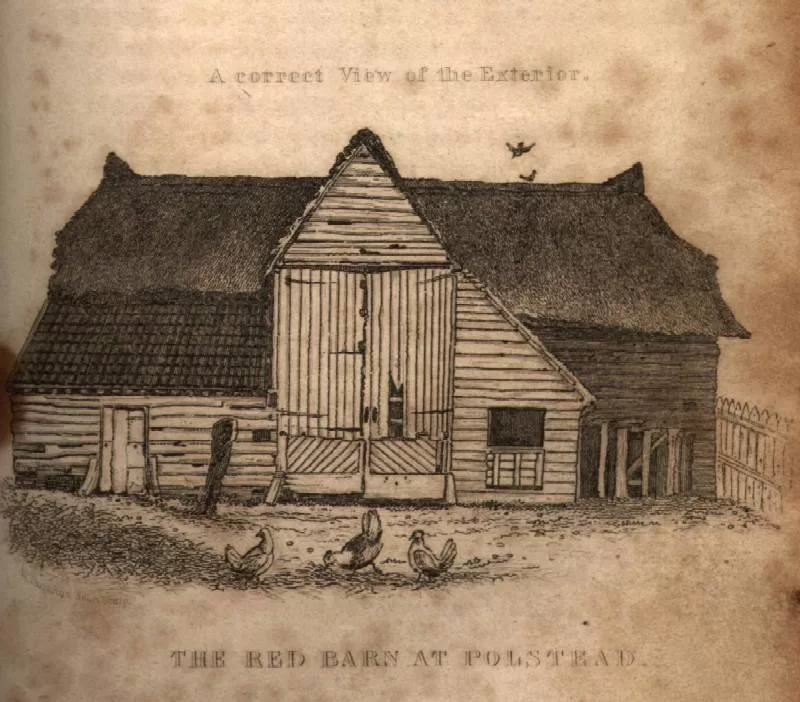
The Red Barn at Polstead

Red was particularly common, and this is evident from paintings and stories from the time. Constable’s  ‘Golding Constable’s Flower Garden’ painting (1815) shows a thatched, timber-clad barn painted ochre for example. The famous ‘Red Barn Murder’ of 1827 took place in a barn in Polstead, often mistakenly assumed to be so named because of a small part of its roof being red clay tiled, but it is more plausible that this barn was painted red.

The use of red paint was logical given that it was likely made using linseed oil and iron oxide (i.e. rust powder) both of which would have been readily available on farms at the time. Barns in the USA are still predominantly red, and it is possible that the tradition of using linseed oil and iron oxide was exported from Europe.


Evidence of earlier paints on South Norfolk barn. Image: Jasmine Philpott

There are also examples of weatherboarding being painted white or cream. This would have been achieved wither through distemper (mixing ground chalk with size, a weak glue and water), or mixing slaked lime and water to make a limewash. Pigments could then be mixed with these to achieve a red or yellow ochre. Remnants of both red and yellow paints can be seen on a barn in South Norfolk as evidence of this.

Though not a barn, White Cottage in the grounds of Framlingham College was the only remaining example of a weatherboarded dwelling in East Suffolk until its rather disappointing demolition in 2023. Outside of East Anglia, the Grade II Listed White Barn at Great Dixter House and Gardens in East Sussex dates from the early 18th century and is believed to have always been white.

It is also very plausible that barns would not have been painted at all. There are numerous examples of unpainted weatherboarding to barns. Unpigmented linseed oil may have been used in these cases – indeed, this is still used for exterior garden furniture for example.


The White Cottage in the grounds of Framlingham College, now demolished following a fire (Image: Timothy Eason)

Unfortunately, the common assumption that barns should be painted black is well embedded, and it is likely that a compelling justification would be needed to choose a different colour, if a planning application or listed building consent is required. A 1994 planning appeal relating to a barn that had been painted white as part of a residential conversion concluded that ‘Suffolk barns must remain black’. Literature on the subject is fairly limited, and because the use of tar pre-dated the advent of photography, evidence of earlier pigments is only found through remnants of paints on buildings themselves, paintings and anecdotal evidence.

This is not a call to move away from painting barns black altogether, rather an appeal for deeper consideration before assuming that black is the appropriate choice. After all, we paint our homes a variety of colours, why not re-introduce that diversity into our outbuildings?


Images:

Posted on

A Smoother Property Sale

The english property process by George Berry of Durrants Estate Agents

George Berry, Residential Area Manager, asks why English property sales aren’t smoother like Scotland’s.

On so many occasions from buyers and sellers, I hear: “Why is the English property process such a nightmare and why can’t it be more like Scotland?”

In this day and age, given property is our biggest financial asset why do we have a process that allows buyers to make an offer, proceed with a purchase and then pull out at any stage before exchange without any come back. Given a move can be emotionally stressful and financially strained for many reasons, this scenario only makes it potentially far worse.

For those that can remember a few years ago we had Home Information Packs (HIPs). The idea of these was a good one but like many new things brought in, the implementation was poor and led to their failure. The real strength of them was two things. As vendors had to pay an amount up front it forced a financial commitment to the selling process, albeit a nominal sum. However, any sum seemed to have the effect of clients being less reluctant to dip in and out of the market.

The other real positive was, it pushed vendors to collate far more information prior to launching to the market and notice if ‘necessary’ documents were missing. This meant that theoretically the conveyance process could be shorter and smoother as a sales pack could be created quicker. In addition, buyers could view far more information prior to offering leaving less reasons for them to withdraw down the line. Of course, if people have unexpected financial or health issues that force them to change their plans, then these cannot be helped.

How Preparation Can Make All the Difference

We no longer have HIPs so what can we learn from them and apply to selling our homes to reduce stress and make the process smoother?

1) When deciding to move, it is wise to choose and appoint your solicitor immediately. Get them to send you the protocol forms upon engagement and you can then work through them ensure you find the appropriate documents and certificates. If it transpires that there is paperwork missing or things need addressing, then you will have time to deal with it upfront and prior to a sale being agreed.

2) There are three dominant factors that can really make or break a sale; boundary issues or unregistered titles, non-compliant private drainage systems and survey issues.

By engaging your solicitor early will enable you to commence the first registration of the title if required and also clarify any boundary issues versus the official title. I have had a situation recently when the boundary on the ground does not match the Land Registry Plan. This came out towards the end of the conveyance and caused a lengthy delay. If it came to light at the start of the process it could have been addressed.

Regarding private drainage, the Government are doing all they can to try and phase out old septic tanks and by changing binding rules they are making the majority non-compliant. You will not be able to shy away from this issue and you have two options. You can choose to get it replaced with a treatment plant prior to selling so you know there will be no issue, or you can factor it into negotiations and give an allowance to a buyer for its replacement.

3) If you have a property that requires a lot of work, then something to consider is getting a survey done yourself prior to selling so buyers can see it before they offer and can make an informed decision. Alternatively, get a builder to look at issues with a view to getting some resolved or quotes to have them fixed. Renegotiations following a survey are when many sales fall apart. If buyers are more informed when offering as to works required and potential costs it will reduce the likelihood of reductions towards the end when everyone is stressed.

The key to a better and smoother sale is in the preparation. A better presented house will achieve a higher price and a better prepared vendor will achieve a smoother result.

This article was first published in the Diss Express.

Posted on

West Suffolk District Council adopts their new Local Plan

West Suffolk District Council has confirmed that their new Local Plan has been adopted, and will now be used to determine planning applications in the District between now and 2041.

The Plan makes provision for 13,005 new homes and 85 hectares of land for employment growth.

Readers may be aware that the government recently introduced a new methodology for calculating housing need for local authorities. These changes have meant that West Suffolk will immediately start a review of their Local Plan using the new, higher housing need figure.

The policies in the Plan remain similar to those in the previous document. One change of particular interest to our readers is the rural infill policy, SP21, which allows the infilling of a gap within a group of seven or more existing dwellings. In the previous Plan, this was a minimum of ten, and this reduction is welcomed, though a requirement for the settlement to have access to public transport links has been added, and this will present challenges in rural areas.

The Plan includes a policy allowing the conversion of redundant rural buildings to dwellings, but requires 12 months of marketing to demonstrate that employment, economic development, tourism, recreation and community uses have all been ruled out. This is more onerous than similar policies in neighbouring authorities, which usually only require the building to be of architectural merit or the conversion to constitute an improvement in the appearance of the building.

The remaining policies are reasonably standard, though there is a definite focus on green infrastructure and sustainability in this Plan.

If you are interested in property development in West Suffolk, we can help with everything from acquiring land, building consultancy, and selling your development.


Image by Thomas Underwood

Posted on

Government consults on overhaul of Biodiversity Net Gain legislation

Biodiversity article by Jasmine Philpott

Durrants’ Jasmine Philpott, Senior Planner and Development Surveyor, comments on BNG introduced in 2024 and how it has created major challenges for small developers due to unclear guidance, costly rules and limited support – prompting calls for a simpler and fairer system.

When Biodiversity Net Gain (BNG) was introduced in May 2024, it was done so with little guidance or training on how to apply it, and apparently little consideration for the practicalities of delivering it. BNG requires all planning applications to demonstrate a 10% improvement in biodiversity post-development compared to pre-development. It currently applies to almost all planning applications of more than 5m x 5m in area, and requires an on-site ecology survey, the completion of a government-issued metric, and a plan for how the 10% will be achieved.

The biggest issue with BNG that we have encountered is the restrictive rules around on-site versus off-site gain. Current regulations do not allow the 10% gain to be provided within residential garden land, so any owner of a prospective residential development has to either provide off-site solutions on land they own in the area, or purchase credits. An added complication is that off-site solutions require a Section 106 agreement, which take months to agree and hundreds or thousands of pounds in legal fees.

The second issue is that there are not enough consultants, or capacity at local authorities, to process all of this additional work. The entire industry appears to be muddling along and doing everything they can to justify an exemption to avoid BNG altogether. As usual with these types of well-intended but poorly considered schemes, BNG favours large scale developers and big landowners, who have the space to provide on-site BNG outside of gardens, or own spare land and have the in-house expertise and funding to push through the S106 process. This inequity should also be considered in the context of the huge decline in the number of small and medium size developers (SMEs) in the industry – from SMEs obtaining 21% of all planning permissions in 2010-11 to just 9.3% last year.

The government appears to recognise this problem, and it was very welcome news to hear that the government are consulting on a radical overhaul of the BNG regulations to lift the burden on SMEs. I have read and commented on the consultation and thought that almost all of the suggestions were very sensible.

They include a complete exemption from BNG for ‘very small sites’ and a streamlined BNG process for ‘small sites’ (less than 9 homes) and ‘medium sites’ (10 to 49 homes). There is discussion on introducing a standard S106 agreement to avoid inconsistences between law firms and local authorities, and introducing a simplified metric that does not require input from an ecologist.

I was particularly pleased to see mention of stricter validation requirements and measures, as well as plans to reduce the number of planning applications determined by planning committee – something I have advocated for in previous columns (clearly Angela Rayner reads the Diss Express and my articles on the Durrants website).

I appreciate that nature lovers among us (and I consider myself one) may consider this to be a backwards step – the Wildlife Trust are certainly not happy to see BNG being ‘watered down’ so soon after it was launched. However, there is a balance to be struck when it comes to nature and development. If nature protection and enhancement becomes too onerous, it turns developers and the public against it and can lead to attempts to sabotage and destroy habitats to make the process easier. I have always felt, and many of my ecology consultant contacts agree, that small pockets of BNG land scattered across the country are far less effective than large-scale areas set aside for nature. I would therefore like to see governments and business setting up more BNG sites, with smaller developers simply making a financial contribution to these schemes. It does appear that this is the direction that BNG will take in the future, and I think this is a good thing.

This article was first published in the Diss Express.

Posted on

How residential conversions can help town centres flourish and thrive

Residential Conversions by Durrants Estate Agents

As we are all aware the country’s usage of both commercial and residential property has changed over recent years, with more people working from home or on a hybrid basis, leading to a rise in unused commercial and office space. Meanwhile, the rise of online shopping has also taken its toll on town and city centres, with a growing number of empty shops and it has been estimated that 300,000 homes could be created from empty premises above commercial spaces.

Housing demand in the UK continues to grow and an ongoing gap between supply and demand for residential property has led to an increase in the number of change of use applications of commercial premises.

These applications are often for the conversion of empty commercial premises into residential use, and this can be appealing to property investors as the homes created have the potential to be rented out to tenants.

Private tenants are also more likely to want to live in a town or city centre, where amenities, infrastructure and transport already exist, whilst being close to a place of work. This means that landlords can find even greater demand for residential property in converted commercial spaces.

Recent research has revealed that in the last four years there has been a 63% rise in commercial to residential property change of use applications in England and instances where these conversion applications were approved also increased by 60% over the same period – down to a combination of a higher level of applications, as well as the easing of some Planning regulations.

Conversions can be viewed as a more sustainable property investment, as the building structure and surrounding amenities are already present, meaning less outlay. The growth in tenant demand for city and town centre living, can potentially provide residential property landlords with a reliable, long-term income.

It is apparent that the property market is constantly evolving and, as demand for residential property continues to soar, it has increased the attractiveness of converting unused commercial spaces above retail units into domestic use.

Other advantages are that mixed-use retail and residential development help to keep town centres alive, enabling nearby businesses which are still viable – such as gyms, theatres, cinemas, shops, hair salons, barbers, public houses, restaurants and cafes – to flourish and thrive with the consequential increase in local residents.

At Durrants Building Consultancy we have noticed the increase in enquiries from Clients asking for advice regarding the conversion of retail and commercial properties in the town centres of Diss, Harleston and Southwold into residential use, particularly at First Floor level and above.

We have already successfully achieved Planning permission for two residential conversions above retail remises in Diss and a residential conversion of an entire retail unit in Southwold and are currently involved in looking at another four separate premises in Diss and Harleston with a view to achieving the same result.

We are of the view that this is a burgeoning market and there is considerable scope in this sector, particularly as the Government and many Local Authorities are actively encouraging the repurposing of these spaces for residential use.

Recognising the potential of retail and commercial premises to have a future mixed use or residential use is an important consideration for existing owners and potential purchasers of commercial properties and, if it is felt that a property might have some potential, just contact us in Durrants Building Consultancy and we will be only too happy to give you some initial, informal advice which hopefully will assist!

Posted on

Listen to the market

Listen to the market by George Berry from Durrants

George Berry, Residential Area Manager, looks at why realistic pricing is key to selling your house in today’s market.

Listen to the market

Why do shops and retail outlets have sales on and off throughout the year? The simple answer is to sell stock that has been lingering and make room for new stock.

So, flipping that question on its head, why didn’t it sell at its full price to start with? The most common answer is that buyers could not justify the price of the items and only when they were reduced, saw them as good value for money.

With disposable income being low due to the cost of living being high, every penny counts. Items in sales look far better value and more people can afford them. This increase in demand means people feel they will lose out and as a result make quicker decisions to buy.

The same principle applies to the housing market. If a property is not selling, then it is for largely two reasons. It either has compromises that are putting buyers off or they cannot justify the price. The higher the price, the more significant those compromises become.

Properties are our homes and our biggest investment. They are where memories are made, both good and bad, and as a result there is a lot of emotion in the mix. This is what causes an issue.

Detach from emotion

We naturally all want the maximum we can get for our homes when selling to enable us to have more flexibility with onward plans. However, when detaching from emotion, we all know something is only really worth what someone will pay. In a tough market where a lot of supply and demand is hampered by mortgage rates, affordability and  incomplete chains, this can cause problems agreeing sales.

Retailers reduce prices because it will be the make or break of their business. They need sales and money in. If vendors are able to take a more commercial view when selling their homes and look more objectively at the bigger picture, then they will achieve better results.

Be flexible

The key is listening to the market rather than being rigid on what they want to hear. We agreed a sale this week where the buyer floated a lower level and wanted us to discuss with the sellers before submitting a formal offer. The vendors’ response was: “well of course that seems fair, we all need to take an offer”.

In a high-end boutique, one-off garments can command ultra-high prices and buyers will ultimately pay for the exclusivity. That is also the case for certain properties that are so exclusive. They can only appeal to ‘high net worth’ buyers. The issue is, most of our homes do not fall into this category so it is wrong to keep prices unrealistically high in the hope that someone will pay over its market worth. Most buyers are ordinary folk like us with limited supplies of money so they will only pay what they can afford.

I hear it so often on valuations or in conversations: “I don’t want to reduce my price as it makes it look like there is something wrong with the house.” This is not the case at all and mindsets over reductions being a stigma need to change. There is no science to confirm prices other than letting the market determine them. As agents we look at comparables to give a guide but ultimately the market will decide.

If you want to sell, listen to the market and be prepared to reduce. Remember that if you are dropping the likelihood is your onward purchase will also drop as it is all relative. If you can’t afford to take less then what the market deems it is worth then you really should give serious thought to whether you need to sell now. If you can’t then take it off the market as you will only be left frustrated.

This article first appeared in the Diss Express.