Posted on

Supporting Our Community: £1,000 Donation to Feed All Children

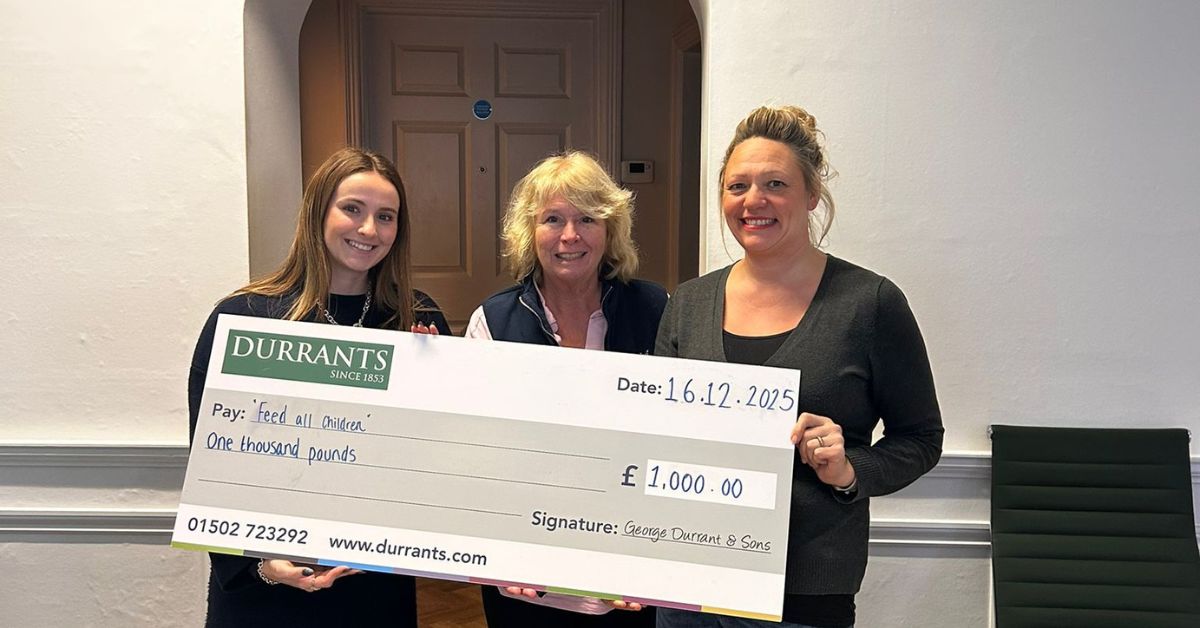
Lily presents a cheque to 'Feed All Children' from the Durrants Charitable Foundation.

At Durrants, supporting our local community is central to who we are and what we stand for. That’s why we’re proud to share that we have donated £1,000 to the Feed All Children initiative from the Durrants Charitable Foundation.

On 16 December 2025, Maddy Durrant and Sarah Jerman were pleased to receive the cheque from Lily Lawrence, Residential Sales Manager at our Southwold branch, on behalf of the project. The moment reflected a shared commitment to helping local children and families during a particularly challenging time.

About Feed All Children

Feed All Children is a project run by Sole Bay Care Fund, a local community charity that works closely with schools, community organisations and support groups to help those in need across the Sole Bay area.

The aim of the project is simple but powerful: to ensure that every child at local primary schools can access a nutritious meal each day. While many children already qualify for free school meals, local schools have a higher-than-average uptake compared to national figures. In the current economic climate, many more families are facing financial pressures that can make providing regular meals a real challenge.

Research linked to the project has shown that when families are struggling, both children and parents may go without food. Feed All Children helps to remove this burden by offering meals to all pupils, ensuring equality, reducing stigma and supporting families who may otherwise fall just outside traditional eligibility criteria. Parents can choose whether to take up the meal or continue paying, preserving dignity and choice.

Making a real difference

Currently operating as a pilot project across several local primary schools for the winter term, Feed All Children is already having a significant impact. Schools are reporting:

  • Improved attendance
  • Better concentration and engagement in lessons
  • Stronger social interaction
  • Improved overall wellbeing

The benefits extend beyond the classroom. Parents have reported reduced stress and anxiety, with some able to redirect household budgets towards other essentials such as heating. This, in turn, improves family wellbeing and creates a more stable home environm

ent.

A personal connection

The project is especially meaningful for Lily, who attended Reydon Primary School and benefited from a similar scheme during her own childhood. Her involvement highlights just how impactful these initiatives can be, not only in the short term but throughout a child’s life.

We are also proud to support this cause alongside Maddy Durrant, a long-term client of ours, making this donation particularly close to home.

Looking ahead


Following a full evaluation of the pilot, Sole Bay Care Fund hopes to extend Feed All Children to more schools

and over a longer period. Achieving this will require continued fundraising and community support, but the early results clearly demonstrate the value of the project.

As a locally rooted business, we believe in supporting initiatives that strengthen our community from the ground up. Every child deserves the opportunity to learn, grow and thrive and we’re proud to play a part in helping make that possible.

If you’d like to find out more about Feed All Children or support the work of Sole Bay Care Fund, we encourage you to get involved by making a donation via their Peoples Fundraising page or visiting their website for more information.

Posted on

Suffolk councils launch simultaneous Call for Sites consultations

Both East and Mid Suffolk Council have launched new consultations seeking future development land as of 20th October.

East Suffolk District Council, which covers both Waveney and Suffolk Coastal, have recently announced that they are starting a Local Plan review. The Local Plan directs growth in the District, including allocating land for specific uses. East Suffolk currently has two local plans, for Waveney and Suffolk Coastal, adopted in 2019 and 2020 respectively.

From 20th October 2025 until 9th January 2026, landowners are able to put forward their sites for consideration as future allocations for housing or employment uses as part of a Call for Sites exercise. This process, known as land promotion, is usually the only way of obtaining planning permission of any scale, and is a long-term endeavour which may result in land being allocated and therefore suitable for development.

Mid Suffolk (which includes the Babergh area) have also launched a Call for Sites in the same timeframe as part of the preparation of their new local plan.

Durrants are able to submit sites for consideration on behalf of landowners, and would encourage anyone who is interested in doing so to contact buildingconsultancy@durrants.com or 01379 646603 to discuss further. Ideal sites are:

  • Within, adjacent to or close to an existing settlement – i.e. a village, town or city
  • Accessible from a suitable road (or access can be created)
  • Not in a flood risk area
  • Not heavily wooded
  • At least 0.25 hectares or able to accommodate at least 5 homes or 500sqm of employment floor space
Posted on

Planning permissions drop to lowest levels since 1979

New Year New Planning framework

Official data released in September showing that planning permissions for new homes have fallen to a record low under Labour’s government have been described as ‘unacceptable’ by housing secretary Steve Reed.

Approximately 7,000 planning applications for new homes were approved between April and June 2025 – the lowest since records began in 1979 and an 8% fall compared to the same period in 2024. A similar report was released in March 2025, when it was confirmed that just 242,610 homes were approved (not built) in 2024, the lowest since 2014, and that overall, delivery numbers were falling annually.

These trends suggest that the government will struggle to deliver the 1.5 million homes promised in their manifesto, which translates to 325,000 homes per year.

A March report by the Home Builders Federation called for action to increase housing numbers, including more support for first-time buyers, addressing problems in the affordable housing S106 market, increasing resourcing to the planning profession (on the local authority side) and recognising the impacts that tax changes and new policy burdens have on development viability.

The government did fund the hire of 300 new planners, but that only equates to one per local authority area. The autumn budget is predicted to introduce more taxes, including a potential overhaul of stamp duty and council tax which could further impact the development sector. The impending changes to the private rental sector will also affect the buy-to-let market, which makes up 20% of housing stock, with buy-to-let investors accounting for 10% of purchases in 2024, down from 16% in 2015.

But the news isn’t all bad. The figures from the summer show that approvals are up by 2%, with 88% of all applications being approved, and 91% of major applications granted on time. And though the number of residential applications granted was at an all-time low, in fairness to Councils, fewer applications were received in the first place, so the drop in numbers is partially on the applicant side.

The fall in planning permissions is surprising given the tangible changes that the government has made to the planning system, notably the shake-up of 5-year land supply calculations, which has meant nearly every local authority in Norfolk and Suffolk is under-delivering on housing. This opens up opportunities to apply for housing which may not previously have been supported. And yet, numbers are dropping. Why?

I have written before about the burdens of Nutrient Neutrality, Biodiversity Net Gain and the increasingly onerous process of validation delaying the planning process. The latest problem faced in many areas is a lack of capacity for sewage in water recycling centres. All of these play their part in deterring developers from the sector, and all of them have been brought about at a government, national level, not a local one. I cannot help but feel that there are fundamental contradictions (or perhaps ignorance) between the government’s admirable aims and the red tape they continue to do very little to manage or mitigate.

In my role working on rural planning schemes in Norfolk and Suffolk, we have seen people increasingly discouraged from pursuing schemes due to rising build costs combined with the unappealing changes to the private rental sector and the slowing of the residential sales market.

On a positive note though, I feel that we are lucky to have some of the best local authorities in the country in this area, most of whom work proactively with us and are very reasonable and fair. We have enjoyed a 95% success rate with our planning applications in 2025 and though this is in part due to our knowledge of local policy and resulting ability to make applications succeed, some of this has to be credited to local planners.

I was listening to PM on BBC Radio 4 last week, and Victoria Hills, CEO of the RTPI (Royal Town Planning Institute) was asked to give a one-word answer to the question, ‘Will the government deliver 1.5 million homes during its term?’. Her answer was ‘maybe’. I confess that I am less optimistic for reasons of simple maths. With only 200,000 homes completed in year one of Labour’s term, delivery would need to almost double overnight to hit the 1.5m target in the remaining 4 years.

Posted on

Read this before you paint your barn black

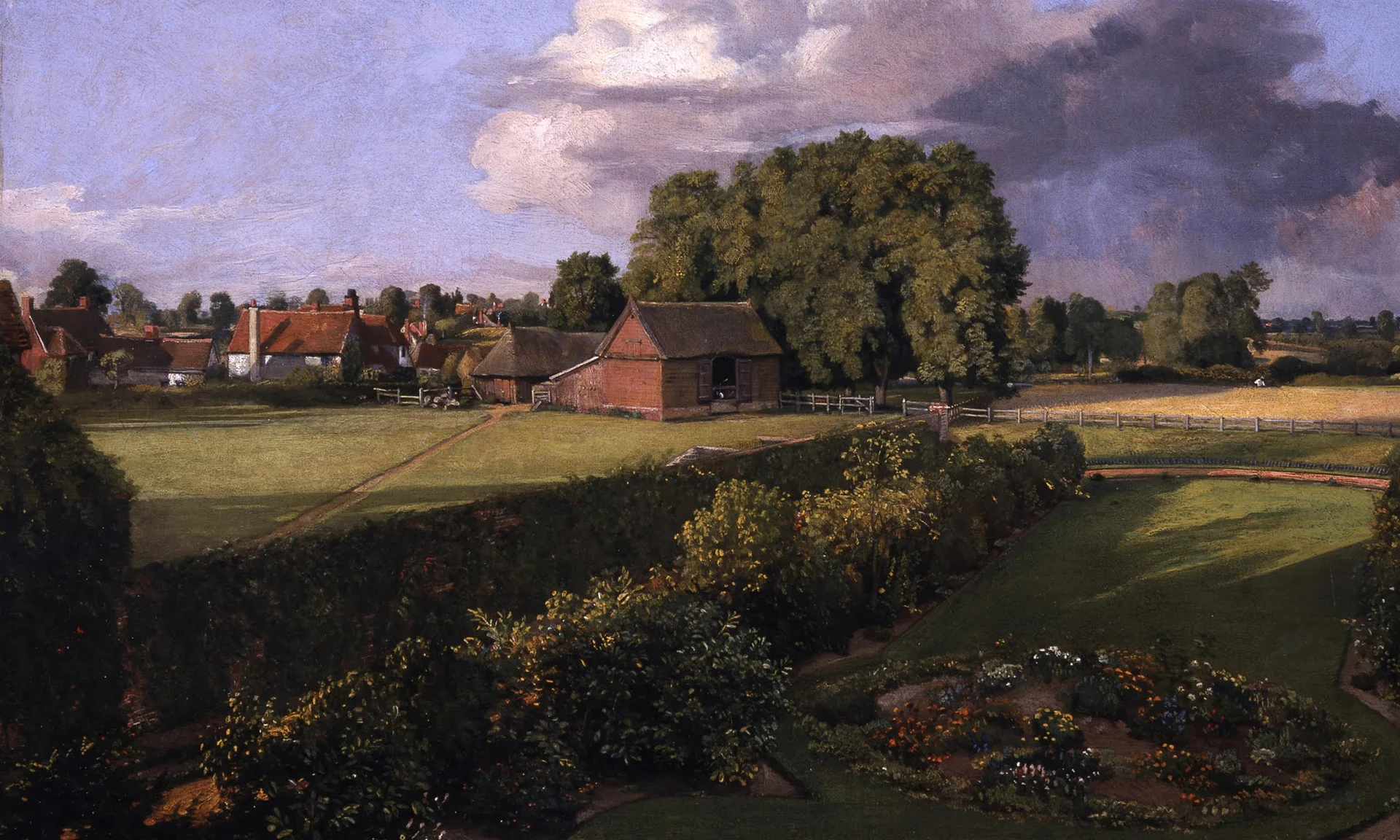
John Constable’s ‘Golding Constable’s Flower Garden’, 1815.

In East Anglia, we are fortunate to benefit from an abundance of traditional farm buildings, most of which are built from either traditional red brick (as well as flint and clay lump) or of a timber frame with wooden cladding.

And just as ubiquitous as the barns themselves is their colour. They are almost invariably black. After all, that is the traditional colour for a timber-clad historic barn, right?

The practice of painting barns black became commonplace in the 1830s, and the black was not paint, but tar, which had protective qualities, preventing rot and damage from insects and water. But before then, timber stains were likely oil-based, probably using linseed oil and various oxides to create a pigment.


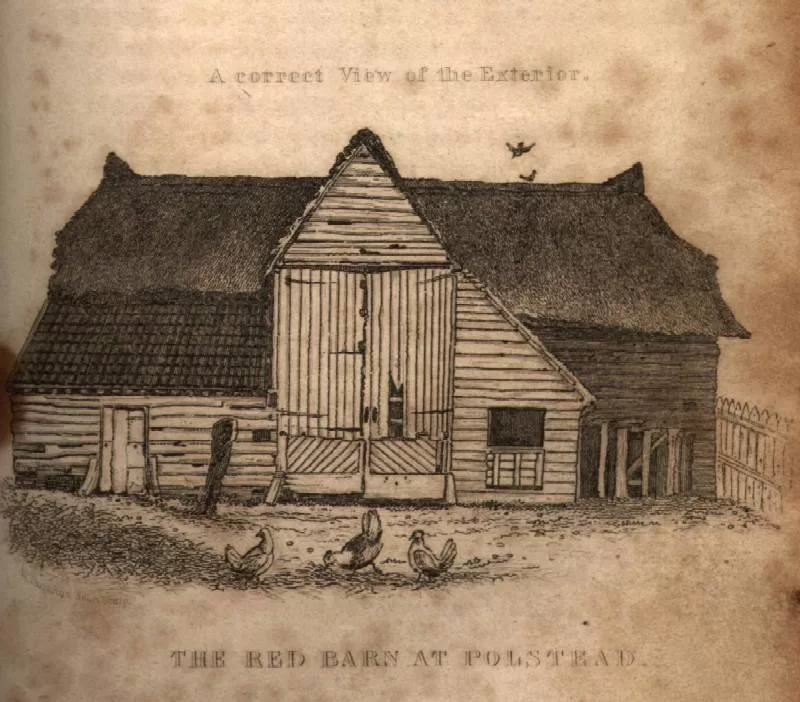
The Red Barn at Polstead

Red was particularly common, and this is evident from paintings and stories from the time. Constable’s  ‘Golding Constable’s Flower Garden’ painting (1815) shows a thatched, timber-clad barn painted ochre for example. The famous ‘Red Barn Murder’ of 1827 took place in a barn in Polstead, often mistakenly assumed to be so named because of a small part of its roof being red clay tiled, but it is more plausible that this barn was painted red.

The use of red paint was logical given that it was likely made using linseed oil and iron oxide (i.e. rust powder) both of which would have been readily available on farms at the time. Barns in the USA are still predominantly red, and it is possible that the tradition of using linseed oil and iron oxide was exported from Europe.


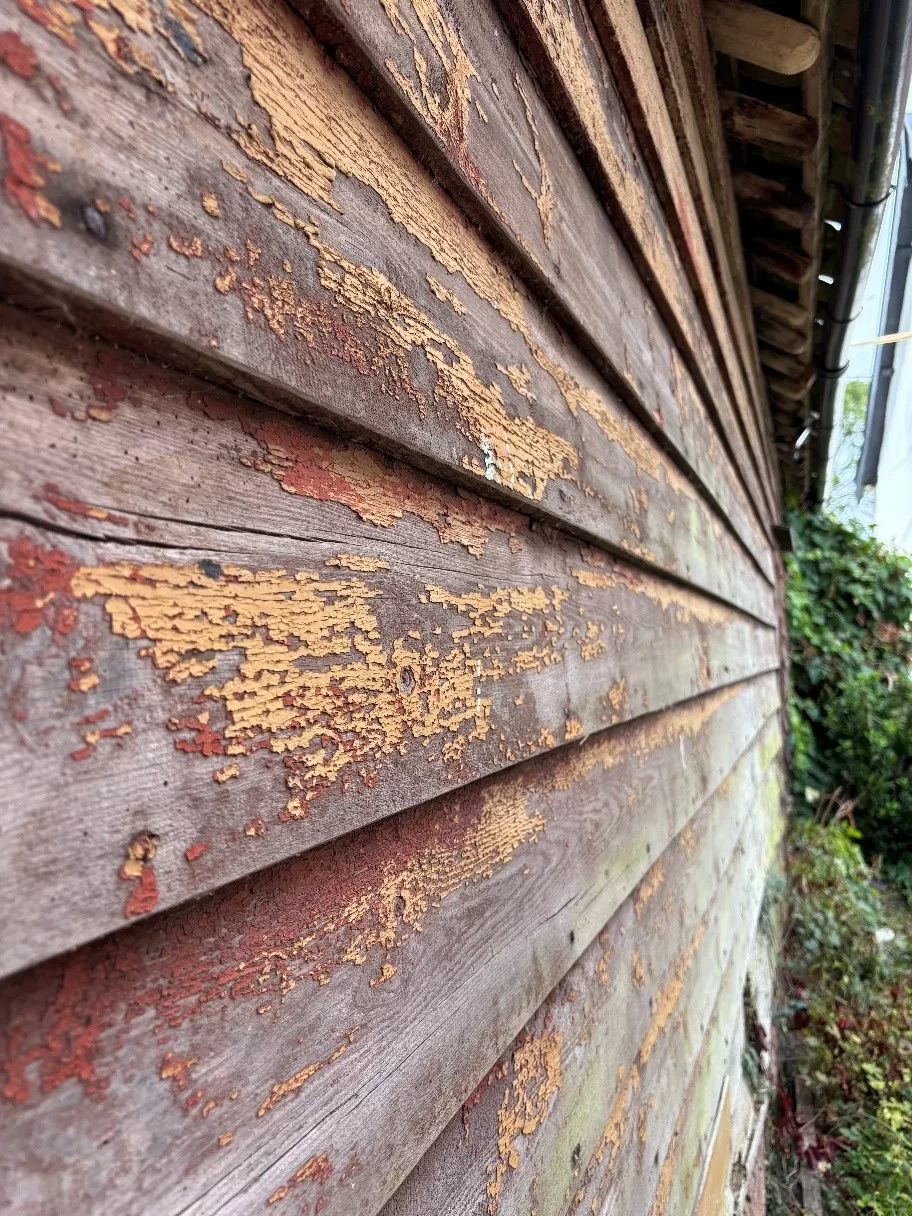
Evidence of earlier paints on South Norfolk barn. Image: Jasmine Philpott

There are also examples of weatherboarding being painted white or cream. This would have been achieved wither through distemper (mixing ground chalk with size, a weak glue and water), or mixing slaked lime and water to make a limewash. Pigments could then be mixed with these to achieve a red or yellow ochre. Remnants of both red and yellow paints can be seen on a barn in South Norfolk as evidence of this.

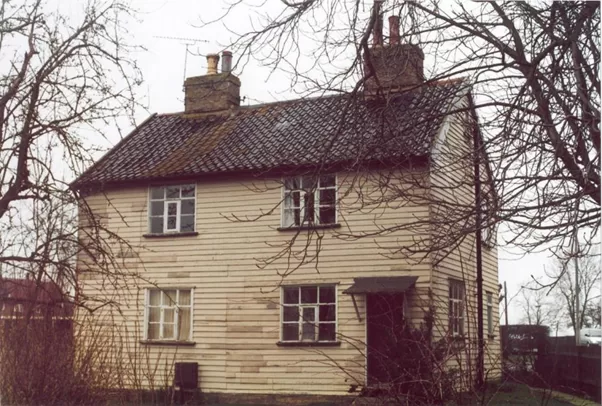
Though not a barn, White Cottage in the grounds of Framlingham College was the only remaining example of a weatherboarded dwelling in East Suffolk until its rather disappointing demolition in 2023. Outside of East Anglia, the Grade II Listed White Barn at Great Dixter House and Gardens in East Sussex dates from the early 18th century and is believed to have always been white.

It is also very plausible that barns would not have been painted at all. There are numerous examples of unpainted weatherboarding to barns. Unpigmented linseed oil may have been used in these cases – indeed, this is still used for exterior garden furniture for example.


The White Cottage in the grounds of Framlingham College, now demolished following a fire (Image: Timothy Eason)

Unfortunately, the common assumption that barns should be painted black is well embedded, and it is likely that a compelling justification would be needed to choose a different colour, if a planning application or listed building consent is required. A 1994 planning appeal relating to a barn that had been painted white as part of a residential conversion concluded that ‘Suffolk barns must remain black’. Literature on the subject is fairly limited, and because the use of tar pre-dated the advent of photography, evidence of earlier pigments is only found through remnants of paints on buildings themselves, paintings and anecdotal evidence.

This is not a call to move away from painting barns black altogether, rather an appeal for deeper consideration before assuming that black is the appropriate choice. After all, we paint our homes a variety of colours, why not re-introduce that diversity into our outbuildings?


Images:

Posted on

West Suffolk District Council adopts their new Local Plan

West Suffolk District Council has confirmed that their new Local Plan has been adopted, and will now be used to determine planning applications in the District between now and 2041.

The Plan makes provision for 13,005 new homes and 85 hectares of land for employment growth.

Readers may be aware that the government recently introduced a new methodology for calculating housing need for local authorities. These changes have meant that West Suffolk will immediately start a review of their Local Plan using the new, higher housing need figure.

The policies in the Plan remain similar to those in the previous document. One change of particular interest to our readers is the rural infill policy, SP21, which allows the infilling of a gap within a group of seven or more existing dwellings. In the previous Plan, this was a minimum of ten, and this reduction is welcomed, though a requirement for the settlement to have access to public transport links has been added, and this will present challenges in rural areas.

The Plan includes a policy allowing the conversion of redundant rural buildings to dwellings, but requires 12 months of marketing to demonstrate that employment, economic development, tourism, recreation and community uses have all been ruled out. This is more onerous than similar policies in neighbouring authorities, which usually only require the building to be of architectural merit or the conversion to constitute an improvement in the appearance of the building.

The remaining policies are reasonably standard, though there is a definite focus on green infrastructure and sustainability in this Plan.

If you are interested in property development in West Suffolk, we can help with everything from acquiring land, building consultancy, and selling your development.


Image by Thomas Underwood