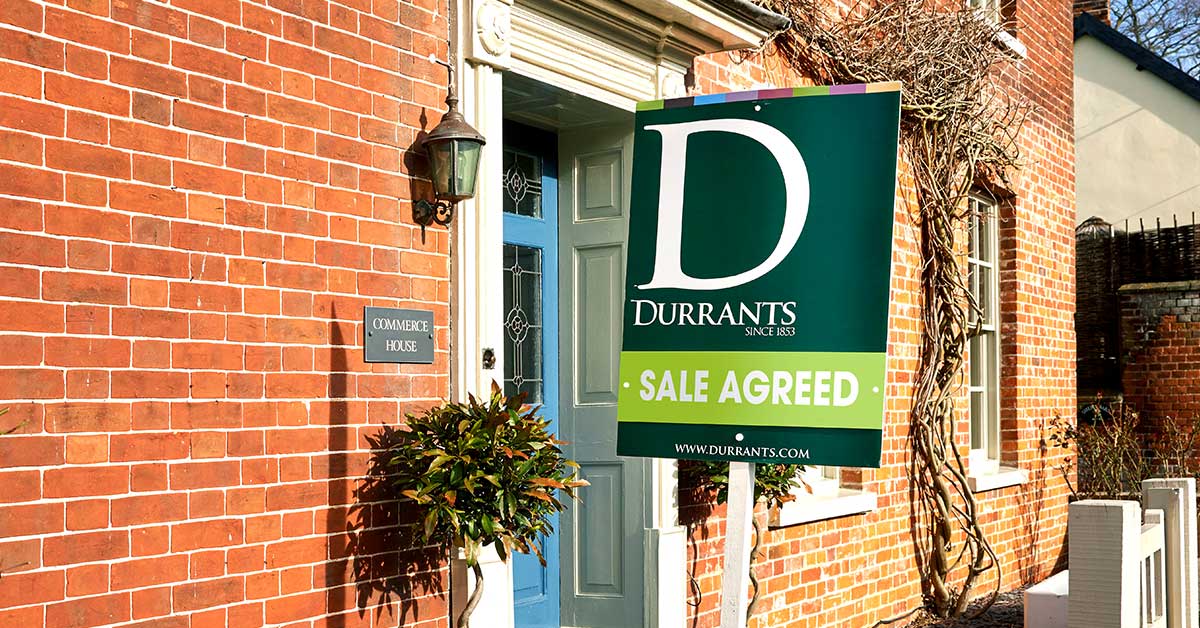
George Berry, Residential Area Manager asks should you sell first or buy first?
The wonderful rhetorical question of: “chicken or the egg, what came first?” is synonymous with the moving home process. I hear you asking yourselves, where on earth is he going with this? When we sit discussing homes and think we may want to make a move, the first thing we do is hit the portals, either to see what is available or alternatively what our own homes may be worth. Having made the decision to move, this then leads on to the bigger question: do we sell our house first or do we look for our perfect new home first? Hence, the chicken and egg analogy.
Of course, both scenarios pose issues, hence the dilemma. If we sell first but can’t find, then what do we do? ‘We can’t rent as we have animals’ and ‘it will be dead money and we cannot afford to do that’ are two comments I often hear. Alternatively, ‘if I find my perfect home but haven’t sold, will I lose it because I can’t proceed?’. It is a really tricky conundrum. However, I do feel there is a solution and that involves transparency and openness.
My advice and especially in a challenging market, is always try and get a buyer on your property first. However, ensure your agent makes it very clear to buyers that it is subject to you finding a property. If your property is the dream home of that buyer, they will be patient and be prepared to wait. If it emerges down the line that you need to find, then that will be where things go wrong. Buyers are far more prepared to be patient and work with you if you respect them and are open and honest from the start.
I am a firm believer in fate and when you have secured a buyer, then start looking and more often then not, the right house for you will appear. I would not advise trying to view houses if you are not on the market. You will not be taken seriously as a buyer as you are not showing any commitment. The selling process is stressful and many owners spend a great deal of time getting their homes ready for a viewing. If you are not on the market, then most owners will see it as a waste of time and in many cases not allow the viewing in the first place.
Another scenario affected by the ‘chicken and egg’ is the selling of probate properties. In this case emotions are heightened for obvious reasons so getting the right advice is crucial. I often hear executors saying they will not launch till probate has come through as it can take a long time. Or I get told ‘I understand I can’t sell until probate has been granted’. It is correct that you can’t exchange until probate has been granted but you can market the property and agree a sale. The conveyance process can take place too but will just press pause until probate has come through.
It would always be my advice to commence marketing as soon as you are emotionally ready and run it in tandem with the probate application. Again, if potential buyers are made aware that probate is awaited and they know that when they offer they are far more likely to be patient. If you wait until probate comes through, then you may miss a big chunk of the marketing window and the market conditions may have deteriorated by the time you come to launch. As executors of an estate, you have the responsibility to get the best price, please listen to the agents when they feel the right time to launch is and don’t just assume it should be when you have the probate certificate.
So, in essence my advice is to lead the process with marketing your home first and then let the search follow. That way, you will not be disappointed if your dream home comes to the market and you can’t secure it.
Dominic Parravani of Durrants explains what being an estate agent really means.
Some people think an estate agent’s job is easy. They imagine that property just sells itself, that a buyer appears from nowhere, loves a house or flat and agrees to buy it for the full price – just like that. Some think the sale then speeds effortlessly to a satisfactory conclusion and without any other assistance. Spoiler alert: it doesn’t work like that – well not for most of the time anyway.
In reality an estate agent’s job is not simply to sell houses but to move people. Moving anything is often complicated, can be fraught with difficulty and have unforeseen consequences. Just think about moving twin six-year-olds singlehandedly from bed to school every weekday morning, or moving a flock of sheep from one hillside to another. Both take planning, patience, knowhow, experience and resolve. It means expecting the unexpected, problem solving and often the highest level of tact and diplomacy.
Few inexperienced in the art would try moving a flock of sheep. Instead they would hire a shepherd. And, in a way, that’s what estate agents are. They arrange for something with lots of moving parts – each seemingly with a mind of its own – to end up where it should be on the date and time it is supposed to be there. Estate agents shepherd people, contracts, surveys, mortgages, removals, withdrawals, gazundering, false starts, disappointments, the unforeseen and triumphs from one place to another. Sometimes it’s a smooth process. But all too often it isn’t. Some may think it’s not worth paying for a shepherd. But in the end when it’s been pouring with rain all day, the quad bike has broken down, a fox snatched a lamb and a large group of unreasonable ewes made a long break for freedom, a shepherd is worth every penny.
The best estate agents enjoy being shepherds. Some people may think that selling houses is not much of a job and on the face of it they might be correct. But moving people and families on to the next stage of their lives and making it as seamless and stress-free for them as possible is a tremendous skill and a job worth doing well.
As we approach St Valentine’s Day, Durrants MD Dominic Parravani looks at the similarities between selecting a partner and choosing a home.
In February our thoughts turn to romance and we might ask ourselves: is it possible to fall in love with a home?
When looking for a partner it’s true that some people are attracted by an intended’s looks, social status, bright future, and bank balance. But many people are attracted more by an indefinable spark and connection.
It’s just the same with property. There are those calculating the UK residential property market’s resilience in a time of uncertainty. They monitor the Bank of England’s policies concerning lowering interest rates, government housing initiatives, changing societal norms, sustainability and overall consumer confidence. But where’s the romance in that?
One should undoubtedly do one’s homework and check out the cupboards for skeletons, but often finding the right home is not so much based on a financial transaction but more on dreams, aspirations and an immediate deep sense of belonging. From the moment you enter the right house or flat for the first time, it is like coming home. An emotional connection is forged. The space suits your mood or is adaptable to your many moods; it reflects who you are and gives you comfort by supporting and protecting you.
So one doesn’t have to be the most romantically inclined person to understand that the answer to the question, “Is it possible to fall in love with a home?” is a resounding yes.
Now, let us help you find your perfect match, because in property at least we understand how love works.
Get in touch with Durrants today. Click here for details of your nearest office.
Durrants Jasmine Philpott, Senior Planner and Development Surveyor looks at government planning reforms taking place this Spring.
Secretary of State for Environment, Food and Rural Affairs Steve Reed confirmed that the government will be consulting on planning reforms to encourage farm diversification in the Spring.
This is welcome news in the wake of recent planning reforms, which have been largely focussed on the delivery of housing, with little mention of farming or rural development.
Further detail has yet to be released, but Mr Reed stated in a speech at the Oxford Farming Conference that the reforms will make it ‘quicker for farmers to build farm buildings, barns and other infrastructure they need to boost their food production’. This appears to include expanding permitted development rights to enable larger barns to be converted into a farm shop, holiday let or sports facility. The current regulations allow for up to 1,000sqm across a holding to change to a flexible commercial use, but this does not currently include holiday lets, which would need full planning permission. Mr Reed appeared to also allude to greater permitted development rights for constructing new buildings.
Readers will recall that last year saw the expansion and relaxation of permitted development rights for farmers, with more options for converting buildings to residential and commercial uses, though little had changed with regards to new agricultural buildings.
We look forward to seeing draft legislation in the Spring, and will report back in detail when it is released.
Durrants Jasmine Philpott, Senior Planner and Development Surveyor comments on the updated NPPF which focuses on sustainable development with stricter housing need calculations and measures to boost housing delivery across the UK.
New Year, new planning framework
Many of us will have read the headlines regarding the new government’s promise to reform the planning system in order to build 300,000 homes a year.
As part of this, the government published a new National Planning Policy Framework (NPPF) on 12 December 2024, following a consultation this Spring (see our earlier article – Three big changes in planning and how they could affect you). The NPPF is the starting point for all planning decisions and local plans, and sets out strategic policies which guide priorities and principles for decision making across the country.
Planning applications are ultimately determined in accordance with each area’s local plan, but the NPPF guides how local plans should be created, what they should contain, and provides a fall-back set of policies where a local plan is either silent or irrelevant. The NPPF also dictates how housing need should be calculated for each region, and it is this area that has seen the most change in the new Framework.
The overall message of the NPPF remains unchanged: to achieve sustainable development. However, this version is more pro-development, with an emphasis on local authorities delivering more housing and more infrastructure.
So, what are the key changes, and how will they affect the planning system in Norfolk and Suffolk?
A new housing need calculation
All local authorities (LPAs) must be able to demonstrate that they have a 5-year supply of land for housing (5YHLS), plus a buffer of 5% as a contingency. Under the new NPPF, LPAs must be able to demonstrate this every single year – it is no longer enough to refer to the 5YHLS that was set out in their local plan.
Crucially, the methodology for calculating housing need has changed, and all LPAs must use the new standard methodology. The calculation is now based on a minimum of 0.8% of existing housing stock in the area, and the less affordable the area is, the higher the percentage of growth must be. Affordability is based on the ratio of median house prices in proportion to median incomes. As an example, in an area where this ratio is 9:1, the growth number would be 1.76% per year.
Once this need figure is calculated, the LPA must then convert this into a housing requirement, which also factors in the needs of specific groups, such as the elderly, students, those with disabilities and of course, affordable housing.
It should be noted that local authorities whose local plans are in advanced stages of preparation can avoid these new measures.
New sanctions for under performance
In addition to this new metric for calculating housing need, the government has introduced measures to incentivise authorities to perform. Where an LPA’s housing delivery has fallen below 95% of their requirement over the previous three years, the must prepare an action plan to identify how delivery will be increased. Where delivery has fallen below 85%, the LPA must prepare an action plan, and add a buffer of 20% to their housing requirement. And if delivery falls below 75%, an action plan must be prepared, with the 20% buffer included, but importantly, the ‘presumption in favour’ applies, explained below.
The presumption in favour of sustainable development effectively means that where an LPA has under-delivered housing as set out above, their local plan policies are deemed to be nul and void, and planning applications should be approved unless significant adverse impacts of doing so can be identified. The local plan polices in question could for example be those requiring barns to be of historic or architectural merit to qualify for conversion, those restricting rural housing developments to either affordable-led or infill schemes, those restricting the expansion of intensive poultry sites, or even housing allocations which include a cap on the total number of homes acceptable. This means that in local authority areas where there has been a pattern of under-delivery, planning applications that would normally be refused could be approved either by the authority, or if needed, at appeal.
What this means for your site
In reality, the changes will not have an immediate effect on planning in most areas. We expect local authorities to confirm their positions over the coming months, as they come to terms with the new methodology and work out what action they need to take.
As a general rule, local authorities in Norfolk and Suffolk rarely feature in the worst performing ones across the country, so we are not expecting the presumption in favour to apply to many in our area. However, for those currently preparing a local plan (which includes Mid Suffolk, Breckland, North Norfolk and West Suffolk), it is possible that they will now need to plan for more housing than they would have done before. This means that if you have a site with long-term planning potential, you should consider instructing an agent (such as us) to assist you in promoting it when the opportunity arises.
In areas where the presumption in favour does apply and/or there is no 5YHLS, this could mean that you could make a speculative application at risk and gain an approval where you would not have previously.
Are any local areas affected by this?
So far:
∙Breckland have admitted in a recent decision notice that they cannot demonstrate a 5YHLS.
∙Mid Suffolk have confirmed they will have to start again with their local plan in order to meet the new requirements.
∙Kings Lynn and West Norfolk do not have the required housing supply and the ‘presumption in favour’ applies there
∙Great Yarmouth are seemingly rushing to get their draft local plan submitted before March so that they avoid these new measures.
My opinion
We knew that change was afoot when Labour were elected, and changes made to the NPPF by the Conservative government just before the election were widely criticised at the time. It is no surprise that the onus is on local authorities to lead the charge in delivering more housing, and the NPPF goes as far as it reasonably can in this regard.
However, anyone working in the planning system on a daily basis will know that the causes for delay and under-delivery run far deeper than the changes made to the NPPF can reach.
The ever-increasing amount of information which needs to accompany an application to even make it valid is one such example, the most recent being Biodiversity Net Gain. The requirements for even basic ecology surveys have become more onerous (and therefore expensive), and many parts of the country are in the Nutrient Neutrality (NN) catchment, where development has completely halted. The government has not found a solution to this yet, and arguably needs to if they are expecting local authorities within the NN catchment to deliver the housing growth that they are demanding.
Similarly, the burden of unnecessarily onerous planning conditions is often overlooked – many of these need to be addressed before work can even start. The abuse of extensions of time, the ability for LPAs to set their own validation lists, and the influence of local politics are just some of the causes of delay in the planning process that these changes to the NPPF will not address.
George Berry, Residential Area Manager, looks at the post Christmas rush to Rightmove and how the pressures of the season prompt us to reassess our homes and lives.
It is madness that after all the frenetic run up to Christmas, parties and hosting and not to mention the expenditure, that it ends abruptly on Boxing Day. It is the day that Rightmove witnesses its biggest web traffic of the year.
What does that tell us? Either people are bored and escape into the dream world of a new home search or the tensions of rarely dedicated time with each other makes us re-evaluate our lives. It is a sorry state of affairs that divorce lawyers complete the vast majority of their annual target in January.
We all get caught up on the treadmill that is our lives and it takes real effort to get off it. However, maybe we need to pause and change our annual festive patterns to alter the potential path of the fate. For instance, if we went on holiday rather than have Christmas at home, stresses and strains may dissipate. In addition, the sheer commercialism of all the gifts may be reduced to focus on time with loved ones rather than be suffocated by wrapping paper and Sellotape.
Do you need some space?
Not only does hosting the volume of family and friends test even the strongest of relationships but it puts pressure on the spatial abilities of our homes. Room swapping, inflatable beds and blankets on sofas can also be a big driver to Rightmove to suggest the need for more space.
With family together, it is often a time for big plans and big conversations and the reality of situations becomes apparent. Maybe it is an elderly relative showing signs they can no longer be independent or a boomerang child and their partner craving their own space but unable to get on the property ladder. Is it any wonder we are seeing a rise and return of multi-generations pooling resources and buying one property with annexe accommodation to provide for these changing needs?
So, as we make plans for the forthcoming year and new resolutions it is a perfect chance to focus. Will a new house move really paper over the cracks or do we need to look at the mirror and address the issues and concerns closer to home first?
Do you need to move at all?
Maybe redecorating, decluttering, re-configuring furniture or even room uses may make a start and it might become apparent that that a home move is not even required. A potential garage conversion or extension may provide for the additional space that the festivities highlighted was needed.
The grass of a new home may initially appear greener and whilst for many the reality may well be the case we must not rule out that our existing home may be able to solve our needs. With careful consideration and planning it may also increase the value. Of course, there may come a time when a move is required and we may need to upsize but as mortgage rates increase and living costs rise, the probability is higher that the next move will be a downsize. If only to buy time before we can potentially upsize again.
When the economy is tough and the purse strings strained it is a perfect chance to evaluate what we really need. Combine this with the festive period, as we all clamber around shops for presents and then post-Christmas bargains, the one thing we all lack but costs nothing is time.
Spending time with family and friends costs far less but gives so much more. It is a perfect chance to have a new year, a new you and maybe not necessarily a new home.
Durrants MD Dominic Parravani ignores the New Year crystal ball and instead spreads some hygge around the property market.
Hygge – pronounced hue-gah – is a Danish word. It isn’t easy to translate into English, but to Danes the word means a cosiness and comfortable conviviality that brings on a deep feeling of contentment. You can have hygge with family, with friends or just by being at home.
As there isn’t too much hygge in the wider world at present, people have increasingly come to prize the well-being their home gives them as much if not more than the monetary value of their property.
Why is this? Buyers and sellers tell us every day that in this uncertain world owning their property gives them an unmatched security blanket. Let’s face it, most of us often prefer to be in our small, secure and comfortable world for a while, rather than the more uncertain outside one.
The past few years have been a period of extreme, even historic economic, political and financial disruption. Yet the property market has prevailed because of a need that pays no heed to economics, politics or mortgage fix: the market remains strong despite all the turbulence because most people still want to live under their own roof.
We should like to wish all our friends, neighbours, buyers, sellers and future clients the happiest and healthiest New Year, and if 2025 is going to be the year you make a move we are here for you and with you all the way. Do call us – we can’t wait to spread the hygge.
Durrants Jasmine Philpott, Senior Planner and Development Surveyor describes a South Norfolk Class Q appeal success story.
Durrants and a longstanding client are celebrating this week after a Class Q application on a redundant farm near Harleston were overturned by the Planning Inspectorate, despite being refused twice by the Council.
18 months after the first Class Q application was refused, PINS allowed the appeal and awarded costs against South Norfolk Council for their unreasonable behaviour during the appeal.
The background
Class Q allows for the change of use of an agricultural building to one or more dwellings. Class Q legislation is more restrictive than planning policy, but is generally also less subjective, meaning it is usually easier to predict whether an application will succeed.
The barn in question was surrounded by numerous redundant farm buildings owned by the applicant. They were empty at the time the application was made. Another agricultural building in separate ownership was located around 40m from the application site. As part of the first application, Durrants showed the redundant buildings to be demolished on plan, and suggested that their demolition could be conditioned as part of the planning approval. This was standard practice in South Norfolk previously, and Durrants had made numerous applications in which buildings outside of the application area were conditioned for demolition in this way.
The refusal
The first Class Q application was unexpectedly refused, as the Council was of the opinion that it was not possible to impose planning conditions on Class Q approvals anymore, and that the buildings would need to be demolished before a new application is made.
As many readers will appreciate, demolishing buildings can be very costly, and would have been a risky course of action given that there was a chance that a subsequent application might be refused.
The Council were also of the view that the neighbouring barn outside the applicant’s ownership could be intensified in use, in a way that could result in noise, odour and insects disturbing future occupants.
Durrants resubmitted the application, supported by noise and odour reports from independent consultants, both of which found that the risk of any disturbance in these regards was low. Alterations were also made to the design to provide additional mitigation against these risks. The Council’s Environmental Protection Officer (EPO) had no objection to the application. The Council however refused the application for a second time despite the findings of the reports and their EPO.
The appeal
An appeal was subsequently lodged. During the appeal, the Council conceded that their position on the ability to place conditions on prior approvals was wrong. Half of their reason for refusal thus fell away.
The Inspector ultimately allowed the appeal, citing the noise and odour reports, the lack of objection from the EPO and the reality that future residents of a rural area will reasonably expect a degree of disturbance from agricultural activities as reasons for her conclusion. She also agreed with Durrants’ argument that the barn outside of the applicant’s ownership was too small to ever be used intensively.
This appeal was a huge win for us and our client, and set an important precedent on this issue that will be useful for future Class Q applicants in South Norfolk and elsewhere.
This article first appeared in the Diss Express, published 13th December 2024.
Dominic Parravani of Durrants explores how sci-fi can help a large group of house sellers replace starry-eyed ambition with more earthly logic.
Many of those old enough to remember the original Star Trek TV series may now be considering making a most important move – leaving their starship and downsizing. With no need for lots of space, which is expensive to run and increasingly difficult to maintain, an easier life beckons in more suitable accommodation.
This is a pivotal moment for people of a certain age who are preparing to boldly go and seek out a new life. The decision to downsize and move is not one to be taken lightly, as it involves significant amounts of money and the lure of a comfortable future lifestyle. The gravity of this choice underscores its importance.
For some help in this matter it is useful to adopt the logic and emotional detachment of Mr Spock rather than the unquestioning optimism of Captain James T Kirk. For instance, which is more important, that you move house cleanly, quickly and easily or you hang out for an arbitrary selling price you feel your home is worth or which has been suggested to you by friends and family? Without any doubt Mr Spock would advocate that moving is the more important outcome and that the price you achieve will inevitably be what someone else is willing, ready and able to pay. As Mr Spock once said in season 3, episode 9, “In critical moments, men sometimes see exactly what they wish to see.”.
Adopting logic, dampening sentiment, and engineering sales are what estate agents do every day. They are the Spock and Scotty on board the Enterprise, indispensable to the process. Just as Capt. Kirk can’t do without them, sellers need the expertise of their estate agents to guide them through to their next voyage. Live long and prosper!
George Berry, Residential Area Manager looks at the importance of your guide price when selling a home and what buyers and sellers can do to achieve the best results.
When selling a house, the higher the guide price, the more significant comprises become. When the property market is buoyant, people are more likely to overlook compromises for fear of escalating prices and missing out. However, as soon as the market starts tightening the compromises loom larger.
Therefore, it is crucial when setting a guide price to not be too greedy. Show a buyer you are mindful of the flaws and you have factored them into the pricing. Buyers will appreciate this and it will give you a far stronger hand when they try to negotiate.
There is no getting away from the fact that the market is challenging. Agents that say otherwise are trying to dupe you and you will only be left disappointed by overpromising and under- delivering.
Unlocking the market
There are many people wanting to move but so much of the market is held up but the reliance upon linked transactions and dependant buyers. Many of those are struggling to sell for two reasons.
Firstly, many buyers are struggling with mortgage affordability and the second is overpricing.
I have never witnessed the country and property market come to a pause in the anticipation of a budget like we have just seen. It goes to show how instantly reactive we have become and that is because every pound in our pocket counts and those available pounds are dwindling with tax levels and the cost of living being so high.
If interest rates drop and mortgage rates follow, then we will hopefully see the market start to unlock as this will give more buyers the confidence and funds to move.
What are buyers looking for?
These are some key factors that may help protect the value of your home if the market is tough.
For some time, it has been widely known that there is a ‘Waitrose Effect’. Research by Property Solvers in 2022 showed properties in locations serviced by a Waitrose had higher values than those without. There will be exceptions to the rule for other reasons but generally it is deemed if the location is acceptable for Waitrose then it is a solid area to invest.
Transport links are very important. They always play a pivotal role so when you are selling it will give you a wider buying audience. Towns that have commuting stations will prove to be more resilient as they will appeal to buyers moving into the area. Easy access to Norwich or Diss station is a strong pull for those needing to get to London, or Attleborough and Wymondham for those needing Cambridge.
Schools are hugely significant. Many families will base their entire search around a school catchment. When looking for a school, parents look at Ofsted ratings so it is logical to assume that when looking for a house the school may dictate the location. Therefore if you buy a house because of a good school nearby then your buyers will do the same when you sell.
These three factors are just a handful of things that can give you a wider pool of buyers but also protect the value and saleability of your home.
If you live in areas where you do not have these, please don’t worry. It just means your home may have to work a bit harder in a tougher market. You can help this.
Presentation affects price
There is a direct correlation between price and presentation and if you ensure first impressions are excellent and your home is well-presented, you will put yourself in a far stronger position versus those near you on the market.
That just leaves sensible guide prices. Even in the tough market we are in, we are seeing competition being generated if the guides are attractive. Work with what you have to make it the best it can be and you will ultimately achieve the best result.
Durrants Managing Director, Dominic Parravani, explores how much impact the 2024 Budget has had on property buyers and sellers.
What did the hotly anticipated 2024 budget from Chancellor Rachel Reeves do for those looking to buy or sell a property?
Apart from a few initiatives such as the post Second World War new homes building programme, Thatcher’s Right to Buy legislation, the 1988 cessation of mortgage interest relief at source (MIRAS) and the 2022 mini-Budget, governments don’t often seem to impact the UK property market in a direct way. Significant market fluctuations have usually been the result of referred influence from domestic economic performance and events such as a pandemic and global financial depression, leading to major market upheavals.
This latest budget appears to have done little to move the dial in property, and the jury will be out for a few years until we know if the new government will be able to make good on its promise of planning reforms and its new homes building programme.
So what has the 2024 budget done for us? Apart from what some might term as several mean and short-sighted measures affecting specific market sectors, the budget has removed much of the uncertainty of the past few months for many would-be movers who have been hanging on to see what might happen. The budget has given buyers and sellers room to plan with some predictability. As budgets go, it could have been much worse for the property market.
Durrants Jasmine Philpott, Senior Planner and Development Surveyor looks at affordable housing and discusses why it is such a political hot potato.
In my experience, ‘affordable housing’ is a largely misunderstood term, despite being one of the most talked about topics in political discourse, particularly under the new government.
It is widely known that there is a housing shortage in this country, with a particularly acute need for affordable housing. But what exactly does ‘affordable’ mean, and why are we still struggling to deliver enough affordable homes?
Affordable housing is effectively today’s label for social housing (previously council housing). Unlike market housing, affordable housing is built specifically for those who are on the local authority’s housing waiting list because they cannot afford to rent or buy at market prices.
Affordable housing takes many forms, including social rent (the cheapest form of rent for those on very low incomes), affordable rent (up to 80% of market rent), and shared ownership (where only part of the property is purchased and the rest remains the ownership of the social housing provider).
The key difference between today’s affordable housing and the council housing built before the 1980s is that now, affordable housing is generally not delivered by local authorities. It is almost always owned and managed by Registered Providers (RPs). These are not-for-profit organisations which were set up when social housing was privatised in the 1980s. Some RPs build their own affordable homes, but many of them bid for affordable housing that is part of private-led housing schemes built out by private developers. In this situation, the RP purchases the homes at a percentage of market value, the developer builds them to the RP’s specification, and the RP takes ownership of them once completed, managing them under one of the various tenures listed above.
RPs receive some government funding, but this has been cut in recent years, meaning many of them have set up private development arms to fund their affordable element, which can also allow them to access funding from Homes England. An example of this is Clarion, the largest affordable housing provider in the UK, whose private development arm, Latimer, reinvests all of its profits into Clarion.
As you can imagine, this system is flawed, because it largely relies on private developers to deliver affordable housing, which is often unviable by the time ever-increasing build costs, land values and other costs like CIL, Section 106, biodiversity net gain etc are factored into the scheme. This then means that developers are forced to try to negotiate less affordable housing with the Council.
By comparison, in the 30 years following WWII, more than 100,000 social homes were built per year in England. Social housing made up a quarter of all UK homes by the 1960s. In 2018, just 7,000 were built. Right to Buy in the 1980s gave many people the chance to buy their Council house at a reduced price, but around 175,000 council homes were purchased every year throughout the 1980s under Right to Buy (over 4 million in total), and never replaced.
With around 1.2 million households on the waiting list (and 12,000 in Norfolk), it is easy to see the extent of the shortage and why this subject is inevitably a priority for government. However, some good news is that since the all time low of 2018, last year saw 63,605 affordable homes delivered in the UK. And in our area, Station View, Diss is a 100% affordable scheme, with others underway across South Norfolk.
It should be noted that councils often exercised their powers to compulsory purchase the land needed to deliver social housing during that era, which would be very unpopular today. Planning was also alot more straightforward then, with biodiversity, climate change or even location seemingly of little concern compared to now. So while tempting to yearn for a return of the pre-1980s social housing model, it was certainly not without its flaws.